This guide covers Search, Display, and Shopping campaigns for small-to-mid-sized businesses spending between £300 and £5,000/month. It does NOT address enterprise-level accounts, YouTube pre-roll pricing, or Performance Max campaign budgeting in depth those deserve their own breakdown.
What Does It Cost to Advertise on Google? The Short Answer First
Advertising on Google means paying each time someone clicks your ad not each time they see it. The platform runs on a live auction system, so your actual cost per click depends on your industry, your location, your competitors’ bids, and critically how relevant Google thinks your ad is. There’s no fixed price list.
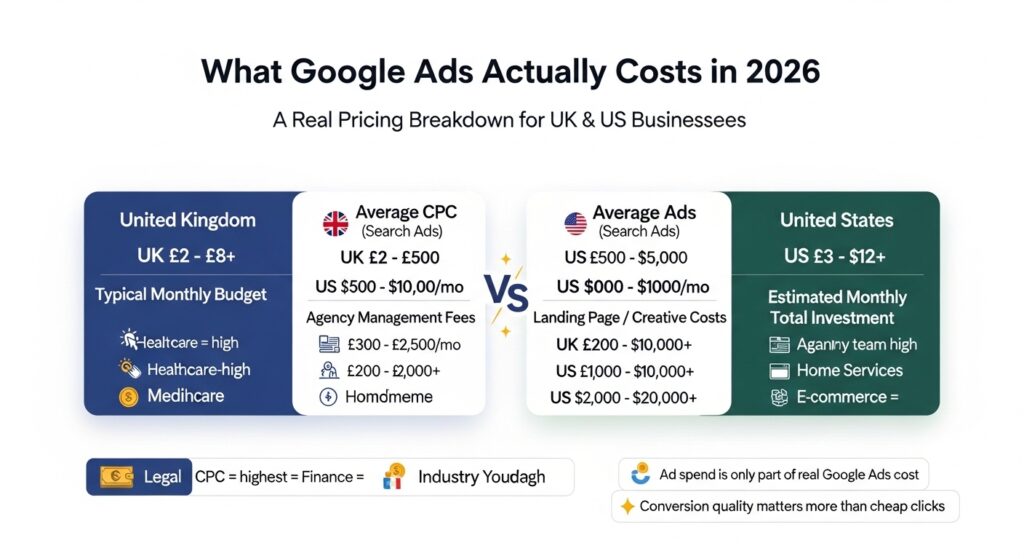
According to WordStream’s 2024 Google Ads Benchmarks report, the average cost-per-click across all industries on Google Search is $4.22 (approximately £3.30). That number ranges from $1.51 in e-commerce all the way past $9.00 in legal services. The average isn’t useless, but it’s not your number. Your industry determines your starting point.
Advertising on Google refers to placing paid ads on Google Search, Display, or Shopping networks through the Google Ads platform. You set a daily budget and pay only when someone clicks your ad. Costs vary by industry, keyword competition, and ad quality the average cost per click across all sectors is approximately £3.30 in 2026.
The cost to advertise on Google depends on your campaign type and industry. According to WordStream’s 2024 Benchmarks, the average Google Search CPC is $4.22 (around £3.30), but businesses in competitive sectors like legal or finance regularly pay £8–£15 per click. Most small businesses spend between £500 and £2,000 per month to run a functional Search campaign with enough data to optimise.
What You’re Actually Paying For And What Moves the Price
Here’s the thing: most guides list industry averages and leave you to figure out the rest. But the number that appears in your billing dashboard is determined by a combination of factors that you can and should influence before you spend a penny.
Quality Score is the biggest one people miss. Google rates your ad on a 1–10 scale based on expected click-through rate, ad relevance, and landing page experience. A Quality Score of 8 versus 4 on the same keyword can cut your effective CPC nearly in half. This is documented in Google’s own official auction mechanics guidance, which explains that ads with higher Quality Scores win auctions at lower prices than lower-quality competitors bidding the same amount.
Or maybe I should say it this way you don’t just compete on money.Google Ads Quality Score explained, You compete on relevance. A well-structured ad pointing to a fast, relevant landing page will consistently beat a larger budget pointed at a poor one.
The other major cost drivers:
- Keyword competition branded and transactional terms emergency plumber London cost more than informational ones
- Match type broad match keywords spend faster and attract more varied (sometimes irrelevant) traffic compared to exact match
- Bidding strategy manual CPC gives you control; Target CPA or Target ROAS hands control to Google’s algorithm, which needs conversion history to work properly
- Geographic targeting London CPCs are typically 20–35% higher than equivalent searches in regional UK cities
What moves your Google Ads cost up or down is largely within your control. According to Google’s official auction documentation, Quality Score a 1–10 rating based on ad relevance and landing page quality directly affects how much you pay per click. Businesses with higher Quality Scores pay less per click than competitors bidding the same or more. Improving your landing page speed and relevance is one of the fastest ways to reduce costs.
Google Ads Pricing by Industry UK & US Benchmarks for 2026
The table below uses WordStream’s 2024 data as a baseline, adjusted for current UK market rates. Treat these as starting estimates, not guarantees.
Quick Comparison
| Industry | Avg. CPC (US) | Avg. CPC (UK Est.) | Best For | Limitation |
| E-commerce / Retail | $1.51 | £1.20–£1.80 | Product-level Shopping ads | High volume needed to convert profitably |
| Home Services (plumbing, electrical) | $6.40 | £5.00–£8.00 | Local Search campaigns | Tight geographic targeting essential |
| Legal Services | $9.21+ | £8.00–£15.00+ | High-value single cases | Low CVR means high CPA — budget carefully |
| Healthcare / Dental | $4.24 | £3.50–£6.00 | Appointment-led campaigns | Strict Google healthcare ad policies apply |
| Financial Services | $7.16 | £6.00–£10.00 | Lead generation for products | Regulated — requires Google certification |
🔗 WordStream 2024 Google Ads Benchmarks
Quick note: the UK figures are estimates. Exchange rate fluctuation and local competition levels mean your actual CPC could sit 15% above or below these numbers. Use Google Keyword Planner before you commit to a budget. It gives you real CPC forecasts for your specific keywords in your specific location.
What Budget Do You Actually Need? The Minimum Viable Calculation
This is where most articles stop being useful.
I’ve seen conflicting data on this, some sources say £300/month is fine to start, others argue you need £1,500+. My read is: it depends entirely on your target cost-per-acquisition and your industry’s conversion rate, not on an arbitrary minimum.
Here’s the calculation that matters:
To work out your minimum viable Google Ads budget:
- Identify your target CPA what you can afford to pay to acquire one customer
- Find your industry’s average conversion rate (WordStream publishes these by sector)
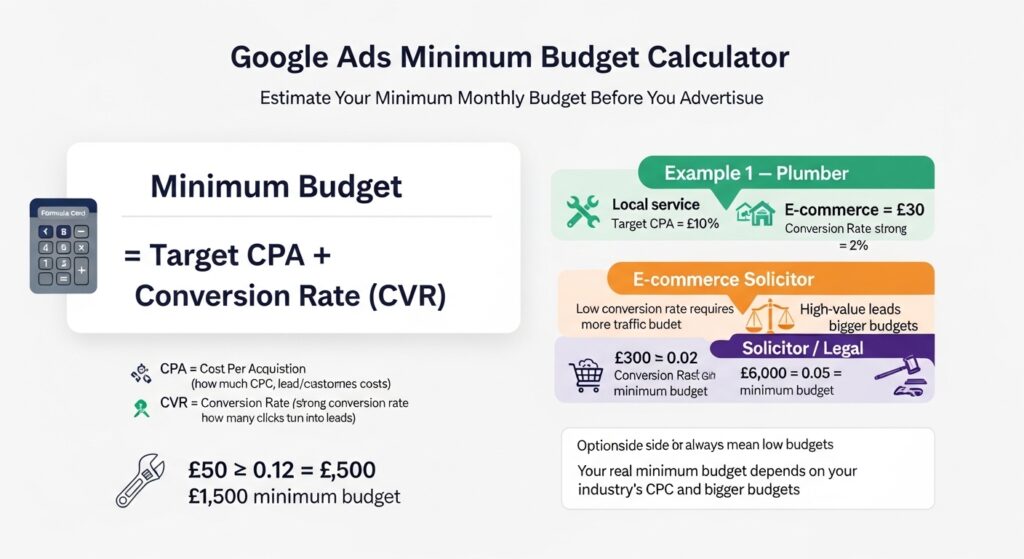
- Divide: Minimum budget = Target CPA ÷ Industry CVR × enough clicks to get 10–15 conversions
Example: If you’re a solicitor targeting a £100 CPA, and the legal services conversion rate is roughly 2.5%, you need approximately 40 clicks to get one conversion. To get 10 conversions (the minimum for Google’s algorithm to start learning), that’s 400 clicks. At £10/click average CPC, that’s £4,000 before your campaign is optimised.How to structure your first Google Ads campaign. That’s not a scare tactic. That’s the maths.
Look, if you’re a local business with a £500/month budget, here’s what actually works: focus on 3–5 tightly targeted exact match keywords in a single campaign. Don’t try to cover everything. One campaign done well beats five campaigns done poorly, every time.
How much you should spend on Google Ads depends on your industry’s conversion rate and your target cost per acquisition. A realistic minimum for a local service business in the UK is £500–£800/month enough to generate around 60–100 clicks and gather meaningful conversion data over 30 days. Spending less than this in competitive sectors usually produces results too thin to optimise from.
Google Search Ads vs Display vs Shopping Which Costs Less and Performs Better
These aren’t interchangeable. Each campaign type has a different cost structure and a different job.
Google Search Ads show when someone actively types a relevant query. They’re the most expensive per click but carry the highest purchase intent. If someone types emergency boiler repair Birmingham, they need a solution now that click is worth paying for.
Google Display Ads appear across millions of websites in Google’s network. CPCs are dramatically lower, often £0.20–£0.60 but conversion rates are far lower too. Display works for retargeting (reaching people who already visited your site) and brand awareness. It’s a terrible primary channel for direct response on a tight budget.
Google Shopping Ads are product-image listings that appear above organic results. They’re essential for e-commerce and often deliver the lowest cost-per-sale in retail verticals. Average CPC runs £0.50–£1.50 in most product categories.
Some experts argue Display campaigns should always run alongside Search to build brand recall. Google Shopping Ads setup guide, That’s valid for businesses with established conversion infrastructure. But if you’re working with under £1,000/month and no optimised landing pages, splitting budget across campaign types dilutes everything. Search first. Always.
How to Estimate Your Google Ads Cost Before Spending Anything
You don’t need to guess. Two tools give you real data before you commit:
Google Keyword Planner (free inside your Google Ads account) shows estimated CPC ranges and monthly search volumes for any keyword in any location. Run your 10–15 target keywords through it before setting your budget. The forecasts aren’t perfect, actual CPCs often run 10–20% higher but they’re the most reliable free benchmark available.
SEMrush or SpyFu (paid, though both offer limited free searches) let you see what your competitors are bidding on and estimate what they’re spending. If a competitor has been running the same ad for six months, it’s almost certainly profitable which tells you both that the keyword works and what CPC range you’re entering.
To estimate your Google Ads cost in 5 steps:
- Open Google Keyword Planner and enter your 10 target keywords
- Set your target location (city, region, or country)
- Note the low and high CPC estimates for each keyword
- Multiply average CPC × estimated monthly clicks to get a rough spend range
- Cross-reference with SpyFu to see if competitors are actively bidding high competition confirms buyer intent
That’s it. No agency needed at this stage.
FAQs
Q: What’s the minimum budget to start Google Ads for a small business?
A: There’s no platform minimum, but realistically you need £400–£600/month to gather enough data to make decisions. Below that, most campaigns don’t accumulate enough clicks in 30 days to tell you anything useful.
Q: How do I know if my Google Ads budget is enough?
A: Divide your target cost-per-acquisition by your industry’s conversion rate to get the number of clicks you need. Multiply by your estimated CPC. If your budget covers at least 50–80 clicks per month, you have enough to start testing.
Q: Should I use broad match or exact match keywords to keep costs down?
A: Exact match first especially on a limited budget. Broad match can surface irrelevant traffic quickly and drain spend before you’ve identified what converts. Expand match types once you have 30 days of clean conversion data.
Q: Why does my Google Ads CPC keep going up over time?
A: Usually because competitor bids have increased, your Quality Score has dropped, or you’ve moved into a broader auction pool through match type drift. Review search term reports weekly and pause irrelevant queries immediately.
Q: When should I hire an agency to manage Google Ads instead of doing it myself?
A: When your monthly budget exceeds £1,500 or your campaigns involve more than two ad groups, the management complexity typically outweighs the agency fee. Below that threshold, a well-structured DIY campaign often outperforms a poorly briefed agency account.