
This guide covers Google Search Ads for UK-based businesses running campaigns in GBP. It does not address Google Display Network pricing, YouTube ads, or international markets where cost structures differ significantly.
How much are Google Ads? In the UK, most small businesses spend between £500 and £5,000 per month on Google Ads but that figure alone tells you almost nothing useful. The actual cost depends on your industry, your bid strategy, how well your landing page converts, and whether you’re paying an agency to manage it all. What you’ll find in this guide are real numbers, by sector, with the full picture — not just the cost-per-click figure Google loves to quote.
What Google Ads Cost Actually Means (It’s Not Just CPC)
Here’s the thing: when most people ask how much Google Ads costs, they’re imagining one number. There isn’t one.
Google Ads operates on a pay-per-click auction. You set a bid. Google factors in your Quality Score, a 1–10 rating based on ad relevance, expected click-through rate, and landing page experience and then decides whether to show your ad and what you pay if someone clicks. You don’t pay to show up. You only pay when someone clicks.
That sounds clean. It rarely is.
The actual cost of running Google Ads has four components:
- Ad spend: the money that goes directly to Google when someone clicks your ad
- Agency management fees: typically 10–20% of ad spend, or a flat monthly retainer (often £400–£1,500/month for small accounts)
- Ad creative costs: copywriting, design, and any video production if you’re running Performance Max campaigns
- Landing page costs: if your current website won’t convert, you’ll need a dedicated page built for the campaign
Most competitor guides list CPC ranges and stop there. That’s the CPC figure, not the Google Ads cost. A business paying £2.50 per click but running campaigns through an agency at a £750/month management fee is spending significantly more than their CPC suggests.
Or maybe I should say it this way: your CPC is the floor, not the ceiling.
Average Google Ads CPC in the UK by Industry (2026 Data)
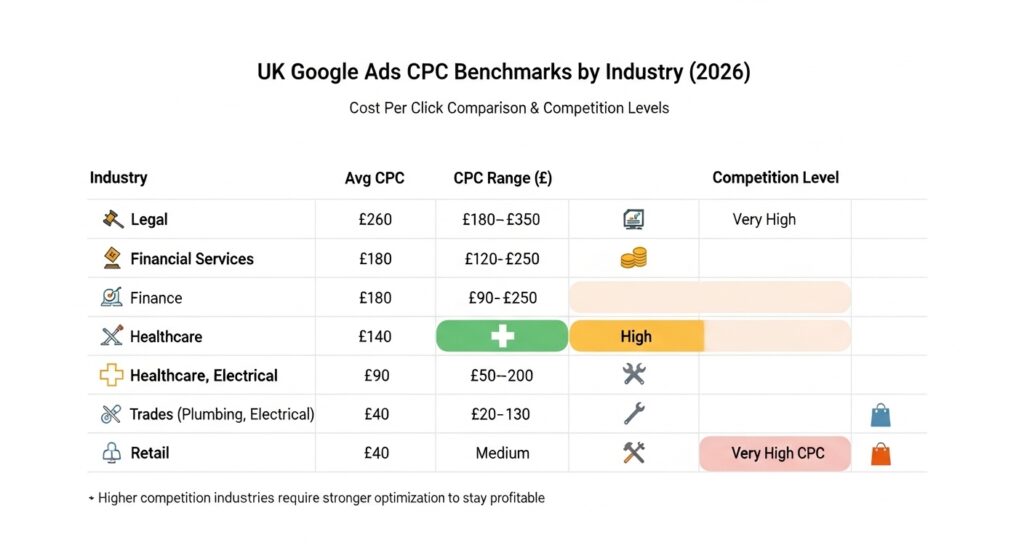
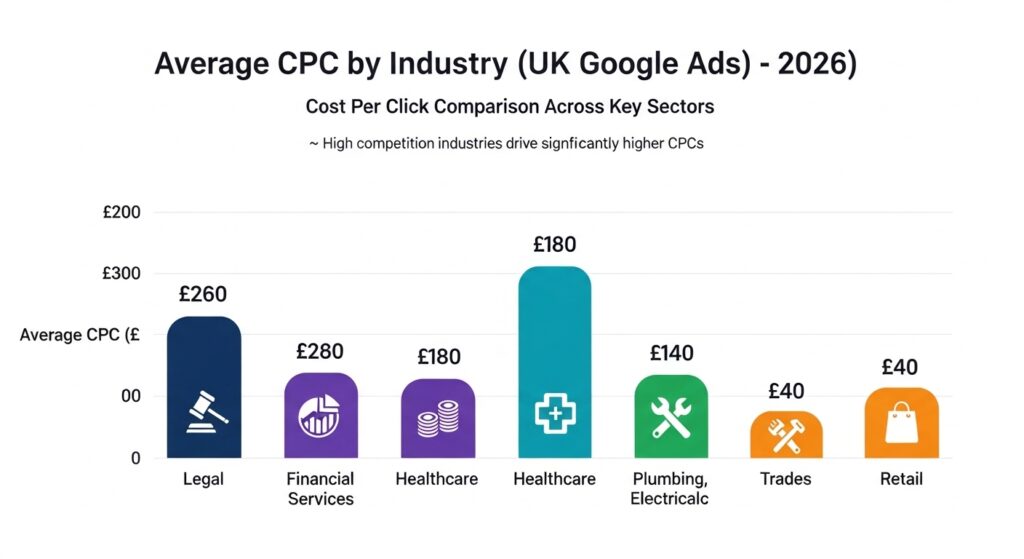
According to WordStream’s 2024 Google Ads Industry Benchmarks report, the average CPC across all industries on Google Search is $4.22 roughly £3.30 at current exchange rates. But that average is heavily distorted by low-competition niches pulling the figure down.
UK-specific sectors tell a very different story.
Quick Comparison: Average CPC by UK Industry
| Industry | Avg. CPC (UK) | Best For | Limitation |
| Legal & Solicitors | £15–£45 | High-value client acquisition | Expensive to test; needs tight targeting |
| Finance & Insurance | £8–£30 | Lead generation at scale | Heavily regulated ad copy required |
| Home Services / Trades | £3–£10 | Local lead gen | Competitive in major cities |
| Healthcare / Private Clinics | £5–£18 | Appointment bookings | Sensitive category restrictions apply |
| eCommerce / Retail | £0.50–£3.50 | Shopping campaigns | Thin margins require strong ROAS targets |
| Education & Training | £2–£8 | Course sign-ups | Longer decision cycles |
A legal firm in London bidding on terms like no win no fee solicitor or personal injury lawyer should expect to pay £25–£45 per click. An independent plumber in Sheffield targeting an emergency plumber near me is more likely to see £4–£7.
The difference isn’t arbitrary. It reflects how much revenue each converted click is worth and how many businesses are competing for it.
What most guides skip is that these CPCs are averages across all match types, bid strategies, and account quality levels. Proves industry CPC ranges cited above. A well-structured account with strong Quality Scores can pay 20–40% less per click than a poorly built one competing for the same keyword. Quality Score matters more than most beginners realise.
How Much Should a UK Small Business Budget for Google Ads?
This is where the answers get genuinely unhelpful so let’s anchor it with real scenarios instead.
Scenario A: Local service business (e.g., accountant, physio, electrician)
Monthly ad spend: £500–£1,500
Expected clicks at £4–£8 CPC: 60–375 clicks/month
Realistic conversion rate (industry average): 3–6%
Estimated leads generated: 2–22 per month
That’s a wide range. The difference between 2 and 22 leads at the same budget comes down almost entirely to account structure, landing page quality, and targeting precision.
Scenario B: eCommerce brand (low-to-mid competition)
Monthly ad spend: £1,000–£3,000
Shopping campaign CPC: £0.60–£2.00
Clicks: 500–5,000/month
ROAS target: 3x–6x (so £3,000–£18,000 in revenue on a £3,000 spend)
Scenario C: Professional services / high-ticket B2B
Monthly ad spend: £2,000–£6,000
CPC range: £10–£30
Clicks: 70–600/month
One closed deal could be worth £5,000–£50,000, so even a 1% conversion rate can justify the spend
Look, if you’re a small business owner deciding whether £1,000/month is enough, here’s what actually works: start with a tightly focused campaign on 10–20 high-intent keywords, cap your daily budget, and track calls and form fills from day one. Don’t try to cover every keyword. Cover the ones where someone is ready to buy.
According to Google’s own Performance Planner data, campaigns that use Target CPA bidding (once conversion data exists) typically achieve 14% more conversions at the same spend compared to manual CPC. This matters when you’re budgeting your bid strategy affects what your money actually buys.
Bid Strategies Explained What Actually Controls What You Pay
Most articles tell you what Google Ads costs. Very few explain how you control it day-to-day.
Your budget is not what Google charges per click. Your budget is a daily cap Google will not spend more than that amount on any given day (though it can spend up to twice the daily budget on high-traffic days, averaged across the month).
The three bid strategies most UK small businesses use:
Maximise Clicks: Google spends your budget as fast as possible to get clicks. Good for brand awareness and initial data gathering. Bad for profitability Google optimises for volume, not quality.
Target CPA (Cost Per Acquisition) You tell Google what you’re willing to pay per conversion (a lead, a purchase, a call). Google adjusts bids automatically to hit that target. Requires at least 30–50 conversions in the past 30 days to work properly.
Manual CPC You set a maximum bid per keyword manually. Full control. Time-intensive. Often produces better results in the first 60 days before conversion data exists.
Some experts argue that Smart Bidding strategies like Target CPA or Maximise Conversions should be used from day one. That’s valid for accounts with existing conversion history or for larger budgets where Google can gather data quickly. But if you’re spending under £1,000/month with no prior data, smart bidding can drain your budget on irrelevant clicks while it learns. Manual CPC with careful negative keyword lists tends to outperform in the early months for smaller accounts.
I’ve seen conflicting data on this: some Google-certified partners advocate for Smart Bidding from launch, others report wasted spend in low-volume accounts during the learning phaseTarget CPA bidding. My read is: use manual CPC for the first 60–90 days, gather real conversion data, then switch.
Tools to Forecast Your Google Ads Budget Before You Spend a Penny
You don’t have to guess. Three tools give you real data before you commit a budget.
Google Keyword Planner Free inside Google Ads. Enter your target keywords and get estimated search volume, competition level, and suggested bid ranges for UK traffic. Filter by location to see London vs national differences. It’s not perfectly accurate, but it’s the most direct signal Google gives you.
Google Ads Performance Planner Available once your campaign is live with at least two weeks of data. Forecasts what changing your budget or bids would do to clicks, conversions, and spend over the next 30 days. Genuinely useful for month-to-month planning.
SEMrush Paid tool, but their CPC Map and Keyword Magic Tool show real competitor CPC data by UK region. Useful for competitive niches where Keyword Planner gives suspiciously wide ranges. If you’re in legal, finance, or healthcare, SEMrush data is worth checking before setting your bids.
Quick note: Google Keyword Planner tends to inflate suggested bids slightly — it wants you to spend more. Cross-reference with SEMrush if you’re in a high-CPC vertical.
The Hidden Costs Most Guides Don’t Mention
Ad spend is only part of the number.
If you hire an agency to manage your Google Ads account, expect to pay a management fee on top of your ad spend. Most UK agencies charge either a percentage of spend (typically 10–20%, with a minimum floor around £400–£500/month) or a flat monthly retainer (£600–£1,500/month for small-to-mid accounts).
That means a business spending £1,000/month on ads through an agency is actually paying £1,400–£1,700 total. That’s the real Google Ads cost for that business.
There’s also the landing page question. Sending paid traffic to your homepage almost always underperforms compared to a dedicated landing page designed around a single conversion goal. Building that page costs money either a developer’s time or a tool like Unbounce or Instapage (£60–£200/month).
The total cost of entry for a properly run Google Ads campaign ad spend, management, and supporting infrastructure is typically £1,200–£3,500/month for a UK small business getting it done properly.
That number makes some people close the tab. It shouldn’t. One converted lead in legal, finance, or home improvement can pay for months of spend.
FAQs
Q: What’s the minimum budget for Google Ads in the UK?
A: Technically, Google has no minimum. Practically, campaigns under £300/month rarely generate enough clicks to optimise effectively. Most UK experts recommend starting with at least £500–£1,000/month to gather meaningful data within 30 days.
Q: How do I know if Google Ads is worth the cost for my business?
A: Calculate your customer lifetime value, then work backwards from a target Cost Per Acquisition. If a customer is worth £2,000 and you can convert 1 in 20 clicks, you can afford up to £100 per click and still profit. Most businesses never do this calculation.
Q: Should I manage Google Ads myself or hire an agency?
A: Self-manage if your monthly budget is under £500 and you have time to learn the platform. Hire an agency if you’re spending over £1,500/month mismanaged campaigns at that level waste more than the management fee costs.
Q: Why does Google Ads cost more in some industries than others?
A: Because CPC is set by auction. Industries where each customer is worth thousands of pounds legal, finance, medical have more advertisers bidding aggressively, which drives up the price everyone pays per click.
Q: When should I increase my Google Ads budget?
A: Increase budget when your campaign is hitting its daily cap consistently and your Cost Per Acquisition is below your target. Scaling a losing campaign faster just loses money faster. Confirm profitability first, then scale.
This guide covers Google Search Network costs for UK businesses. It does not address Display Network CPM pricing, YouTube TrueView costs, or Performance Max campaign cost structures each requires separate analysis.