You’ve probably heard both sides. Someone in a Facebook group swears Google Ads tripled their leads. Someone else burned $2,000 in three weeks and got nothing. Both stories are true and that contradiction is exactly what makes this question so hard to answer cleanly.
Here’s what this article actually does: gives you the data, shows you when Google Ads work, and just as importantly tells you when they don’t.
What “Worth It” Actually Means for Google Ads
Google Ads is a pay-per-click advertising platform where businesses bid to appear in Google search results for specific keywords. Advertisers pay only when someone clicks their ad. Whether it’s worth it depends entirely on your cost per click, conversion rate, and the lifetime value of a customer, not the platform itself.
According to Google’s 2023 economic impact data, businesses earn an average of $2 in revenue for every $1 spent on Google Ads. That’s the headline number. It’s also the number that gets quoted without context constantly.
Here’s what that stat doesn’t tell you: it’s an average across millions of advertisers, including massive e-commerce brands with finely tuned campaigns, professional agencies managing accounts daily, and companies spending six figures a month. If you’re working with $800/month and running your first campaign, your starting point looks nothing like that average.
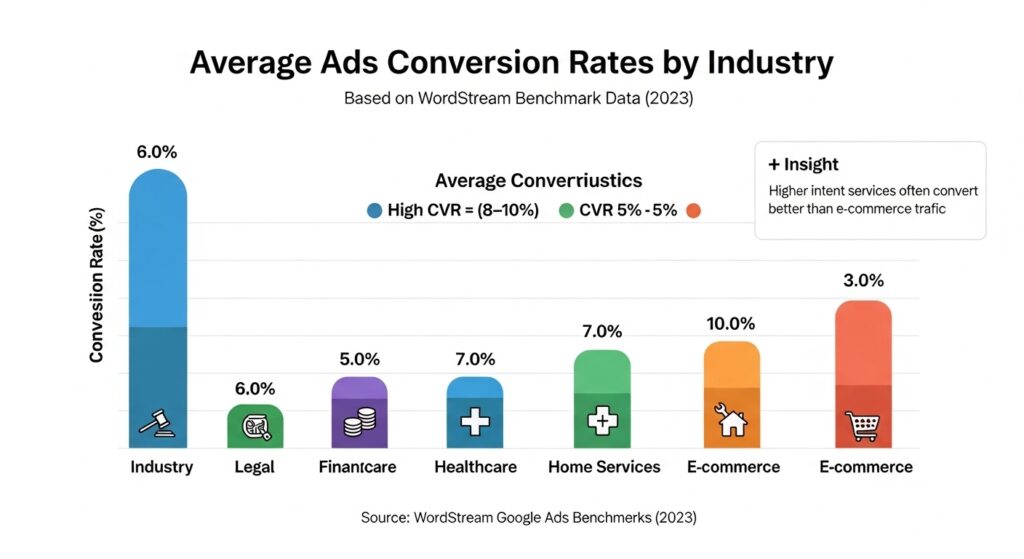
WordStream’s 2023 Google Ads Benchmarks report puts the average conversion rate across all industries at 4.40% on search. But average hides a brutal range legal services convert at around 6.98%, while apparel sits at 2.77%. Your niche, your landing page, and your offer structure matter as much as your budget.
Or maybe I should say it this way: the platform doesn’t determine your ROI. Your setup does.
The Real Costs Behind Google Ads (What Most Breakdowns Skip)
Cost per click gets all the attention. It shouldn’t.
The number that actually determines whether Google Ads work for you is cost per acquisition — what you pay to get one paying customer. CPC is just one input. Your conversion rate is the multiplier that makes or breaks the math.
Here’s how the calculation actually works in practice:
To estimate your Google Ads ROI, follow these steps:
- Find your average CPC using Google Keyword Planner for your target keywords
- Estimate your landing page conversion rate (industry average or your own data)
- Divide 100 by your conversion rate to get clicks needed per lead
- Multiply clicks needed × CPC to get your cost per lead
- Compare cost per lead against your customer lifetime value
If your average CPC is $4.50 and your landing page converts at 3%, you’re paying $150 per lead. If your service is a $200 haircut, that math doesn’t work. If you’re selling HVAC installations at $4,000 a job, it almost certainly does.
Quick note: most guides show you average CPCs without mentioning that branded keywords from competitors can run 3–5x higher, and that Quality Score directly affects what you actually pay. A poorly structured campaign can cost 40% more per click than a well-built one targeting the same keywords.
When Google Ads Are Worth It, The Scenarios That Actually Work
Google Ads tend to deliver consistent, measurable ROI in specific conditions. Not universally. Not automatically. Specifically.
They work well when:
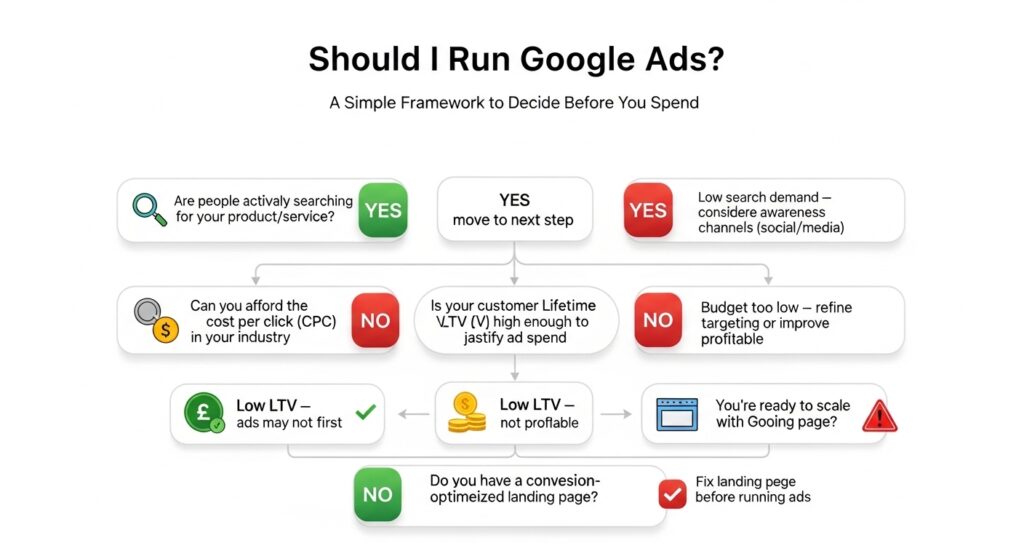
- There’s clear, active search demand for what you sell. If people aren’t already typing for your solution, search ads reach the wrong moment.
- Your customer lifetime value is high enough to absorb a $50–$300 cost per lead. Service businesses, B2B, legal, medical, home improvement these categories regularly justify the cost.
- You have a dedicated landing page, not a homepage. Sending ad traffic to a homepage is one of the most common and expensive mistakes small advertisers make. Users who’ve tried this consistently report higher bounce rates and lower conversion despite adequate traffic volume.
- You can track conversions properly. Without conversion tracking set up in Google Ads (or linked through Google Analytics 4), you’re flying without instruments. You won’t know what’s working, and you’ll waste budget optimizing for the wrong signals.
Look, if you’re a local plumber charging $350 per service call and your Google Ads cost per lead is $45, that’s an excellent return. You don’t need a complicated funnel. You need the phone to ring. Google Ads built correctly can do that.
Quick Comparison:
| Option | Best For | Key Benefit | Limitation |
| Google Search Ads | High-intent buyers ready to act now | Captures demand at decision moment | Expensive in competitive niches |
| Google Display Ads | Brand awareness, retargeting | Wide reach, lower CPCs | Low purchase intent, more clicks needed |
| SEO (organic) | Long-term sustainable traffic | No cost per click | Takes 6–18 months to rank |
| Meta/Facebook Ads | Interest-based targeting, B2C | Strong visual targeting | Lower purchase intent than search |
| Google Shopping | E-commerce product sales | Visual, product-level targeting | Requires feed management, not for services |
When Google Ads Are NOT Worth It
It’s also the section that’ll save you the most money.
Google Ads are genuinely a poor fit in several real situations and being honest about this is more useful than cheerleading the platform.
Don’t run Google Ads if:
- Your monthly budget is under $500 and you’re in a competitive niche. You won’t generate enough clicks to gather meaningful data, optimize your campaign, or test variations. You’ll just slowly spend down a budget and conclude it doesn’t work when really, you never had enough fuel to get off the ground.
- There’s no search volume for what you sell. If you’ve built something genuinely novel, or serve a hyper-niche B2B market, your customers aren’t searching for you they don’t know you exist yet. Display or LinkedIn will work better.
- Your margins are thin. E-commerce selling $30 products? Unless your average order value is being pulled up by repeat purchases or bundles, the math on Google Ads gets brutal fast. A 3% conversion rate at $2.00 CPC means $67 per customer. You can’t absorb that on a $30 item.
- You don’t have landing page infrastructure. If every ad goes to your homepage with no clear offer and no conversion point, you’re paying to generate traffic that has no defined next step.
Some experts argue that any business can make Google Ads work if they try long enough. That’s valid for businesses with enough cash runway to iterate and test. But if you’re working with a fixed $1,000/month budget and no dedicated marketing resource, burning three months of that budget on a campaign that needs fundamental restructuring isn’t learning, it’s just expensive.
Google Ads vs SEO: The Comparison That Actually Helps
I’ve seen conflicting data on this one some sources position Google Ads and SEO as competitors, others treat them as entirely complementary. My read is that they serve different phases of business growth, and the comparison only becomes useful when you anchor it to your timeline and budget.
Google Ads gives you:
- Traffic on day one
- Full control over who sees your ad and when
- Data on which keywords convert useful even if you stop running ads
SEO gives you:
- Traffic that compounds over time without a per-click cost
- Higher trust signals (organic results are perceived as more credible by many users)
- Slower results six to eighteen months before meaningful ranking in competitive markets
Most people assume SEO is always cheaper than paid ads. The data says otherwise. When you factor in content creation, technical optimization, link building, and the time cost of waiting for results, the total investment in SEO often rivals or exceeds a comparable Google Ads budget especially in years one and two.
What most guides skip here: the smartest use of Google Ads for small businesses is often as a research tool. Proves industry-specific conversion rate variation.Run campaigns for 60–90 days, collect conversion data on keywords, then use that data to inform your SEO content strategy. You pay for intelligence, not just traffic.
How to Tell If Google Ads Will Work for Your Business Before You Spend
This is the pre-flight checklist. Run through it before committing the budget.
Before launching Google Ads, confirm these 5 things:
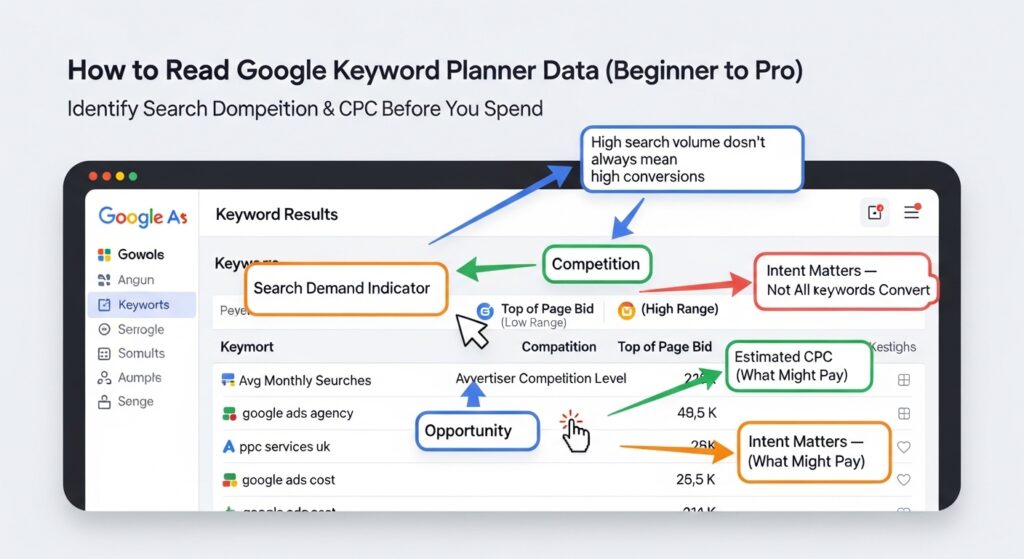
- Use Google Keyword Planner to verify search volume target keywords should have at least 100–1,000 monthly searches in your location
- Check competitor ad presence using a search for your main keyword if no one is running ads, question whether there’s buying intent there
- Calculate your break-even CPA: divide your average order or job value by the minimum acceptable ROAS (return on ad spend)
- Set up Google Ads conversion tracking before the first dollar is spent not after
- Build or audit your landing page against these minimums: clear headline matching your ad, one primary CTA, social proof (reviews, logos, or stats), and a page load time under 3 seconds on mobile
FAQs
Q: What’s the average ROI on Google Ads for small businesses?
A: According to Google’s 2023 economic impact data, the average return is $2 for every $1 spent. However, WordStream’s benchmarks show conversion rates vary from under 3% to nearly 9% depending on the industry making niche and execution the bigger variables than the platform itself.
Q: How do I know if Google Ads are worth it for my budget?
A: Calculate your break-even cost per acquisition first. If your product or service generates enough margin to absorb the cost of a lead based on your industry’s average conversion rate the budget is viable. Under $500/month in a competitive niche rarely provides enough data to optimize.
Q: Should I run Google Ads or SEO for my small business?
A: According to most digital marketing frameworks, the answer depends on your timeline. Google Ads delivers immediate traffic, SEO compounds over 6–18 months. For businesses needing leads now, Google Ads is faster. For long-term cost efficiency, both should run in parallel when budget allows.
Q: Why does my Google Ads campaign feel expensive with no results?
A: The most common causes are broad match keywords driving unqualified clicks, landing pages with no clear conversion path, and the absence of proper conversion tracking. Without tracking, the campaign optimizes for clicks not customers.
Q: When should I stop running Google Ads?
A: Stop if your cost per acquisition consistently exceeds your customer lifetime value after 90 days of proper optimization. Also stop if you’re running under $500/month in a high-CPC niche and can’t gather enough click data to make meaningful campaign decisions.
This guide covers search-based Google Ads campaigns. It does not address Performance Max campaigns, Google Shopping, or programmatic display these involve different cost structures and intent signals.