This guide covers paid search and paid social strategy for small-to-midsize businesses spending between $500–$10,000/month. It does NOT address programmatic display, YouTube-only campaigns, or enterprise-level attribution modeling.
You’ve already spent money. Maybe it was a boosted Facebook post that collected 300 likes and zero sales. Maybe it was a Google Search campaign that burned through $400 in two weeks and produced two phone calls neither of which converted. Either way, you’re here because the generic advice didn’t work.
This isn’t a tie. One platform will outperform the other for your specific business and the answer depends on three things most comparison articles never actually address: your industry vertical, your funnel stage, and whether your audience already knows they need what you sell.
What “Google Ads vs Facebook Ads” Actually Means
Google Ads vs Facebook Ads refers to the choice between two dominant paid advertising platforms: Google Ads targets users based on what they’re actively searching for, while Facebook Ads (via Meta Ads Manager) targets users based on who they are their demographics, behaviors, and interests. The core difference is purchase intent at the moment of the ad impression.
Google Ads runs on search intent. Someone types an emergency plumber near me and your ad appears. That person already wants help. Facebook Ads run on audience targeting. You show an ad to someone who fits your ideal customer profile but they weren’t necessarily looking for you five seconds ago.
Or maybe I should say it this way: Google catches people in the act of buying. Facebook interrupts people who might buy.
Both work. What Is Paid Search Advertising, The question is which one works for your business, right now, at your budget level.
How the Costs Actually Stack Up in 2026
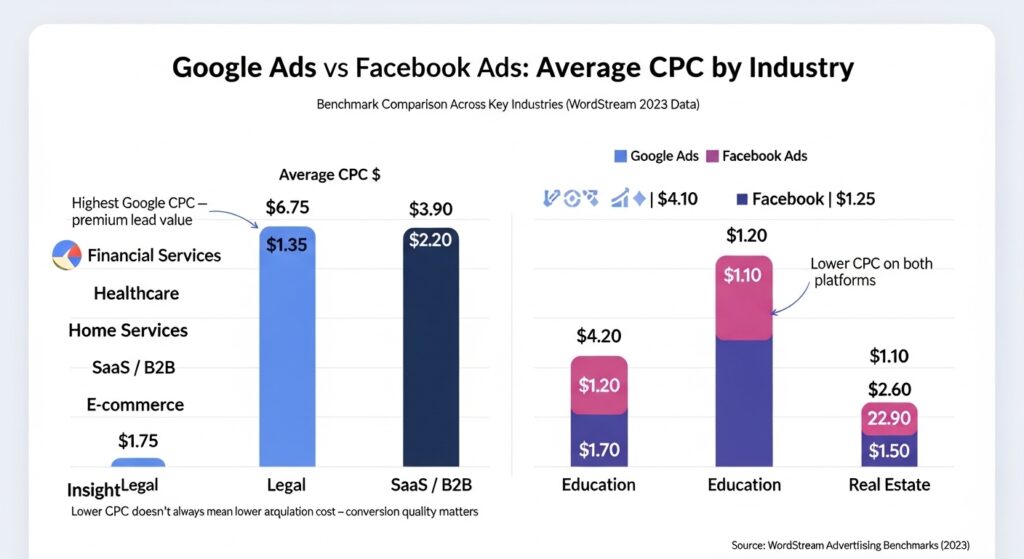
The average cost-per-click across Google Ads industries sits between $2–$9 on the search network, with highly competitive verticals like legal services and insurance pushing $15–$50 per click. According to WordStream’s 2023 industry benchmarks, the average Google Ads conversion rate across all industries is 7.26% on the search network meaning you’re paying for clicks that convert at a reasonable rate when campaigns are set up correctly.
Google Ads CPC by Industry
Costs vary. A lot.
Legal services average $6.75–$9.21 per click. Home services run $6–$12. E-commerce sits closer to $1.16–$2.69. These aren’t small differences — a legal firm and a Shopify store have completely different economic equations on Google, even with the same monthly budget.
Facebook Ads CPC by Industry
Facebook’s average CPC runs lower on paper typically $0.94–$1.72 across most industries. But CPC alone is a trap metric. A $0.94 click that converts at 2% is more expensive than a $4.00 click that converts at 11%. Users who’ve run Facebook campaigns without tracking post-click behavior often report being misled by low CPC numbers that masked poor return on ad spend.
Quick note: Facebook CPMs (cost per thousand impressions) have risen sharply since iOS 14.5 Meta’s own data showed a 61% increase in CPM for some advertisers between 2021 and 2023. WordStream 2023 Google Ads Benchmarks Report, That’s the real cost story most comparison articles still aren’t telling.
Quick Comparison
| Platform | Best For | Key Benefit | Limitation |
| Google Ads | High-intent buyers, local services, B2B | Captures active demand — user is already searching | Higher CPC in competitive verticals; needs strong landing pages |
| Facebook Ads | E-commerce, impulse products, brand awareness | Precise demographic/interest targeting at lower entry cost | No active purchase intent; iOS 14.5 hurt tracking accuracy |
| Google Ads | Legal, medical, home services | Dominates high-value service verticals | Steep learning curve for keyword match types |
| Facebook Ads | Fashion, beauty, D2C consumer goods | Visual storytelling drives discovery and impulse buys | Rising CPMs; attribution window changes post-iOS 14 |
| Both (hybrid) | Businesses with $3K+/month ad budget | Full-funnel coverage — awareness + conversion | Requires more management time and dual-platform expertise |
Which Platform Fits Your Business Type
The choice between Google Ads and Facebook Ads depends heavily on industry vertical and where your customer is in the buying journey. According to WordStream’s benchmark data (2023), industries like legal, finance, and home services consistently see higher ROI on Google Search Ads because users arrive with clear purchase intent. E-commerce brands, subscription products, and impulse-purchase goods tend to outperform on Facebook, where visual creative and interest targeting drive discovery.
Google Ads vs Facebook Ads: Google is better suited for service businesses and high-intent purchases because users are actively searching for a solution at the moment of the ad impression. Facebook Ads Strategy for E-Commerce, Facebook works better when your product benefits from visual storytelling, lifestyle association, or reaching audiences who don’t yet know your brand exists. The key difference is demand capture vs. demand creation.
Industries Where Google Ads Wins
These verticals perform better on Google. Consistently.
- Legal services: Personal injury, family law, criminal defense: users search with immediate need, high lifetime value per client makes $15–$40 CPC viable
- Home services: HVAC, plumbing, roofing, pest control: local search intent is extremely high; Google’s Local Services: Ads add an additional trust layer
- Medical and dental Appointment-based services: where the patient is already problem-aware
- B2B software: Users searching specific product categories with budget authority
Look, if you’re a local service business and someone searches roof repair near me, that’s a buyer. Google puts you in front of that buyer. Facebook does not.
Industries Where Facebook Ads Wins
- E-commerce and D2C brands Especially fashion, beauty, home décor, fitness products
- Subscription boxes and impulse-buy products under $80 (lower consideration threshold)
- Online courses and digital products where creative storytelling builds enough trust to convert
- Event promotion Local events, workshops, community-based businesses
Here’s the thing: Facebook’s targeting lets you show a $29 skincare product to women aged 25–40 who follow specific wellness influencers in your target city. Google can’t do that. No one’s typing shows me skincare products I don’t know about yet.
The Budget Split Strategy Nobody Talks About
Most guides force a binary choice. It’s the wrong frame.
For businesses with a monthly paid advertising budget above $2,500–$3,000, running Google Ads and Facebook Ads simultaneously at different funnel stages typically outperforms either platform alone. According to Meta’s own research on multi-channel campaigns, advertisers who paired Facebook awareness campaigns with Google retargeting saw a 35% lower cost-per-acquisition compared to single-platform campaigns. The strategic split assigns Facebook to top-of-funnel brand building and Google to bottom-of-funnel conversion capture.
How to Split Your Budget Across Both Platforms
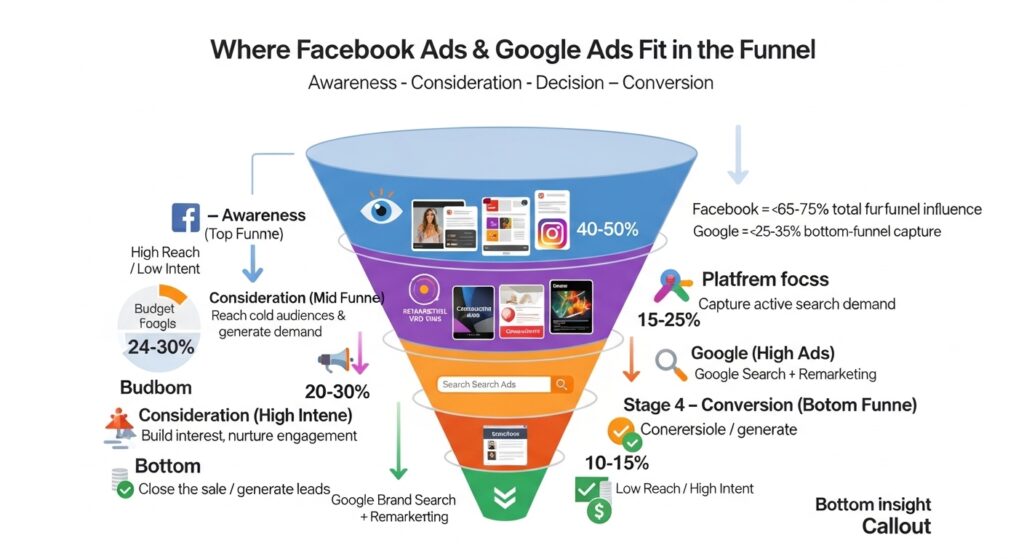
To allocate budget across Google Ads and Facebook Ads for a hybrid funnel, follow these steps:
- Identify your monthly ad budget and your primary goal (awareness vs. conversion).
- Assign 60–70% of budget to Google Search Ads if conversions are the priority.
- Use the remaining 30–40% on Facebook for retargeting and top-of-funnel reach.
- Set up Facebook Pixel and Google Ads conversion tracking before spending a dollar.
- Review platform performance at the 30-day mark shift budget toward the better-performing channel.
I’ve seen conflicting data on the exact split ratio some sources recommend 70/30 toward Google for service businesses, others argue for 50/50 for e-commerce. My read is this: start with 60% Google / 40% Facebook, track 30-day ROAS by platform, then let the data decide the next month’s allocation.
This approach works best for businesses with at least $2,500/month in total ad budget. How to Set Up Google Ads Conversion Tracking. It won’t help if you’re working with $300/month at that level, pick one platform and go deep, don’t spread thin.
What the Conversion Rate Data Actually Shows
Most people assume Google Ads converts better because the traffic is higher-intent.
The data is more complicated than that.
According to WordStream (2023), the average Google Ads conversion rate across all industries is 7.26% on the search network. Facebook Ads average approximately 9.21% conversion rate across comparable campaign types. That’s counterintuitive Facebook, with its interruption-based model, converts at a higher average rate.
The reason? Google Ads conversion rates are dragged down by poorly optimized campaigns. Broad match keywords, weak landing pages, and mismatched ad copy tank performance for advertisers who don’t know what they’re doing. Facebook’s lower traffic volume and tighter audience controls can produce cleaner conversion paths when the creative is right.
Some experts argue Facebook’s conversion rate advantage makes it the smarter default choice. That’s valid for e-commerce brands with strong creative and tight audience data. But if you’re dealing with a local service business or a high-intent B2B product, Google’s intent signal still wins even at a lower average conversion rate because the value per conversion is dramatically higher.
The platform with the better conversion rate isn’t automatically the better platform. Meta Ads Manager Help Center, Your average order value and customer lifetime value change the math entirely.
FAQs
Q: What’s the best platform for a small business with a limited budget?
A: For most small businesses under $1,500/month, Google Ads works better if you offer a local service with clear search demand. Facebook works better for product-based businesses where visual creativity can drive discovery. Pick one and optimize before splitting the budget.
Q: How do I know if Google Ads or Facebook Ads are right for my industry?
A: Check whether your customers search for your product/service on Google before buying. If yes, high search volume, clear purchase intent Google wins. If your product is discovery-driven or visually compelling, Facebook’s targeting is more effective.
Q: Should I run Google Ads and Facebook Ads at the same time?
A: Yes, if your budget allows it, typically $2,500/month minimum. Run Facebook for awareness and retargeting, Google for conversion capture. Below that budget, choose the platform that matches your funnel stage and industry.
Q: Why does my Facebook ad get clicks but no sales?
A: Clicks without sales usually mean one of three things: your landing page doesn’t match the ad’s message, your audience targeting is too broad, or you’re selling a product with a high consideration threshold to a cold audience that needs more touchpoints first.
Q: When should I increase my Google Ads budget vs Facebook Ads budget?
A: Increase Google Ads budget when your cost-per-conversion is below your target CPA and you’re limited by impression share. Increase Facebook budget when your frequency is below 3 and your ROAS is above 2x there’s still audience headroom to scale.
Ready to stop guessing which platform fits your business? Bosthelp Agency runs Google Ads and Meta Ads campaigns for SMBs with full attribution tracking so you know exactly where your ROI is coming from.