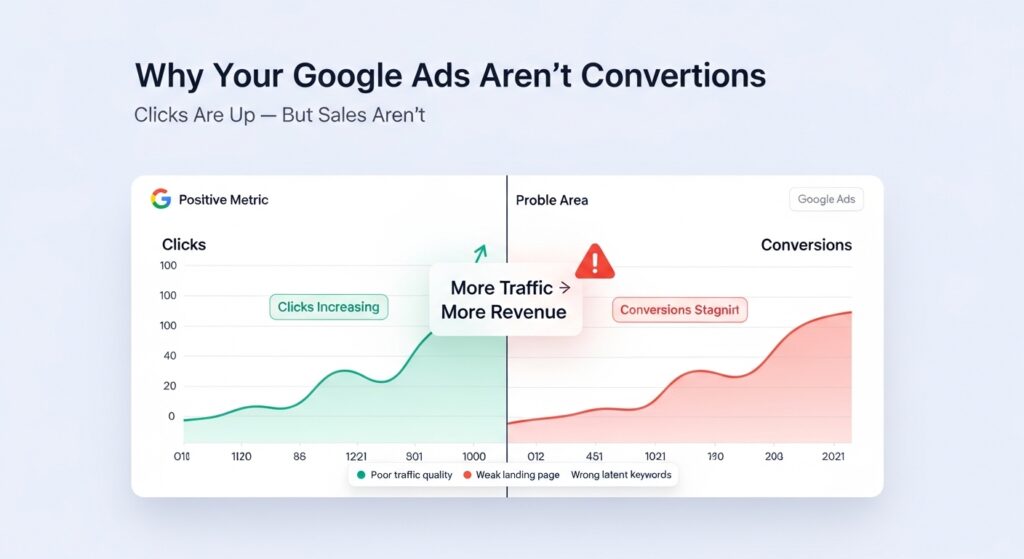
You’re getting clicks. The budget’s running. But the enquiries, the calls, the purchases, nothing.
That’s not just frustrating. It’s expensive. And the worst part is that Google Ads gives you just enough data to feel like you should be able to fix it, without making it obvious what’s actually broken.
This article works through the nine most common reasons UK Google Ads campaigns fail to convert in priority order, starting with the fix that catches the most people out. Work through them in sequence. Don’t skip to the sexy stuff like ad copy before you’ve confirmed your tracking is telling you the truth.
What “Google Ads Not Converting” Actually Means (And What It Doesn’t)
Google Ads not converting refers to a campaign state where paid clicks are being generated but users are not completing the desired action a purchase, form submission, phone call, or booking. This is distinct from low traffic; the problem is specifically that visitors arrive but do not act.
Before you change a single bid or rewrite a single headline, you need to answer one question honestly: are you measuring conversions correctly?
According to WordStream’s Google Ads Benchmarks report (2023), the average conversion rate across all industries on Google Search is approximately 4.40%. If you’re converting below 2%, you likely have a fixable structural problem not just bad luck or a weak product. Proves industry conversion rate baseline. The distinction matters because the fixes for zero tracked conversions and low conversion rate are completely different. One is a measurement problem. The other is a performance problem. Treating them the same way wastes weeks.
Fix 1: Confirm Your Conversion Tracking Is Actually Working
This is the fix most guides bury at the bottom. It belongs at the top.
A significant number of UK advertisers running underperforming campaigns are actually running campaigns that are converting they just can’t see it. Broken conversion tags, duplicate tracking, and misconfigured Google Tag Manager containers are endemic in accounts that were set up quickly or handed between agencies.
Here’s what to check first:
To verify Google Ads conversion tracking is working correctly, follow these steps:
- Open Google Tag Manager and confirm your conversion tag has fired in Preview Mode on a completed form or purchase.
- In Google Ads, go to Tools → Conversions and check each action shows Recording conversions not No recent conversions.
- Use the Google Tag Assistant Chrome extension to confirm tags are firing on the correct confirmation page URL not the form page itself.
- Cross-reference conversion numbers against your CRM or backend order data for the same date range.
Quick note: Google Tag Manager is free, and a basic conversion tag audit takes under an hour. There’s no reason to spend another week optimising bids when you don’t know if the data is real.
One counter-intuitive point here and it catches people out constantly. If you have both Google Ads auto-imported goals from GA4 and manually created conversion actions in Google Ads, you’re almost certainly double-counting. Google Ads will report inflated conversion numbers, your CPA looks artificially low, and Smart Bidding optimises toward ghost conversions. More data isn’t always better data.
Fix 2: Your Keywords Are Attracting the Wrong People
Let’s say your tracking is clean. Conversions are genuinely zero or near-zero. The next place to look is keyword intent alignment.
The UK search landscape has some nuances that generic Google Ads guides from US-based sources completely miss. Search behaviour in the UK skews more research-heavy before purchase, particularly for B2B services and considered consumer purchases. Someone searching Google Ads agency in the UK is often three weeks away from a decision, not three minutes. That’s informational intent dressed in commercial-looking language.
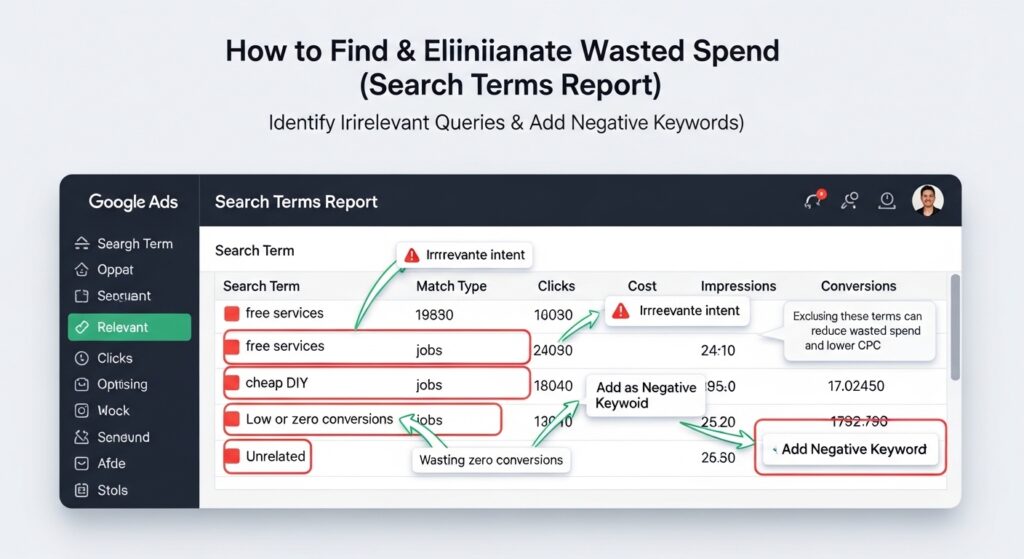
Broad match keywords without strong negative keyword lists are a common culprit. If you’re running broad matches for marketing help and hoping to catch business owners ready to buy, you’re also catching students doing coursework, employees researching for their boss, and people who meant to search something else entirely.
The fix is two-part:
Negative keywords first. Pull your Search Terms report for the last 30 days. Filter for zero-conversion terms with three or more clicks. Add the irrelevant ones as negatives at campaign level not ad group level, or you’ll have to repeat the job.
Then review match types. Phrase match and exact match give you tighter control. Broad match can work but only once Smart Bidding has at least 30–50 conversions per month to learn from. Below that threshold, a broad match is guessed.
Fix 3: UK-Specific Targeting Errors You Might Not Notice
Here’s the thing: Google’s location targeting has a flaw that trips up UK advertisers disproportionately.
By default, Google targets users who are in or interested in your target location. That second part interested in means someone in Dublin or Lagos searching for “London accountant can trigger your ad. For a local UK service business, that’s wasted spend. Every time.
Go to your campaign settings → Locations → Location options. Switch from the default to People in or regularly in your targeted locations. It’s one toggle. It often reduces wasted impressions by 10–20% for UK-local campaigns.
The second targeting error is geographic granularity. Campaigns targeting the United Kingdom as a single unit frequently underperform compared to campaigns broken into regional ad groups London, Manchester, Birmingham, and so on with tailored ad copy, adjusted bids, and landing pages that reference the city. Someone in Glasgow doesn’t want to see a landing page that only mentions London. The relevance signal collapses.
Or maybe I should say it this way: it’s not just about relevance scores. It’s about what happens when a person from Edinburgh lands on a page that feels like it wasn’t written for them. They leave. Immediately.
Fix 4: The Landing Page Is Doing the Opposite of Converting
Ad clicks send people somewhere. That somewhere is doing most of the actual conversion work and most advertisers spend 90% of their optimization time on the ad side and 10% on the page side. It should be closer to 50/50.
The most common landing page failure patterns in UK campaigns:
Slow load speed. Google’s own data shows that pages taking over three seconds to load lose more than half of mobile visitors. In the UK, where mobile search share continues to climb, a slow page is a conversion killer. Test yours at PageSpeed Insights right now.
No clear, specific offer. A landing page that says We help businesses grow is not a landing page. It’s a brochure. The page should answer one question in the first five seconds: What do I get, and why should I trust you to deliver it?
A six-field form kills conversion rates. Name, email, phone, and one qualifying question is usually enough. Every additional field costs you enquiries.
Users who’ve tried A/B testing headlines often report that the bigger wins come from simplifying the form and adding a trust signal near the submit button, a review count, a professional body logo, or a money-back guarantee. The headline rarely moves the needle as much as the trust architecture around the CTA.
Use Microsoft Clarity or Hotjar to watch session recordings on your landing page. Watch where people scroll to, where they click, and critically where they stop and leave. You’ll spot the problem in twenty minutes of recordings. No guesswork required.
Comparison:
Microsoft Clarity vs Hotjar: Clarity is better suited for UK SMEs on tight budgets because it’s completely free and integrates directly with Google Ads via Microsoft’s pixel. Hotjar works better when you need advanced survey functionality alongside heatmaps. The key difference is cost: Clarity costs nothing, Hotjar’s paid plans start at around £30/month.
Fix 5: Your Bid Strategy Doesn’t Match Where Your Campaign Is
Smart Bidding Target CPA, Target ROAS, Maximise Conversions works. But it requires data to learn from. Without sufficient conversion history, Smart Bidding is not smart. It’s a random number generator that sounds authoritative.
The general threshold is 30–50 conversions per month per campaign before Smart Bidding can optimise reliably. Below that, you’re better on Maximise Clicks with a bid cap, or manual CPC with careful monitoring.
Some experts argue that Target CPA is the right starting point for any campaign. That’s valid for mature accounts with clean conversion data. But if you’re dealing with a new campaign or a recently rebuilt account, forcing Target CPA before the learning phase completes will be wildly inefficient for three to four weeks and many advertisers give up and declare the strategy broken before the algorithm ever has a real chance.
I’ve seen conflicting data on this. Some agency case studies suggest pushing through the learning phase regardless of early cost spikes, while others recommend pausing and resetting when CPA spikes beyond 3x target. My read is that patience is warranted up to 2x your target CPA. Beyond that, something structural needs revisiting before you let the machine keep spending.
Fix 6: Ad Copy That Doesn’t Match UK Search Expectations
Look, if you’re running an ad copy written for a US audience and pointing it at UK searchers, here’s what actually happens. The language feels slightly off. The offer framing doesn’t match. Price references might be in dollars. And the specific trust signals that UK buyers respond to Which? endorsements, Trustpilot reviews, FCA registration numbers, no VAT surprises pricing are absent.
UK buyers, particularly in B2B and financial services, are measurably more sceptical of superlatives. “The #1 solution” lands worse in the UK than in US markets. Specificity converts better. Rated 4.9 stars by 312 UK businesses outperforms Award-winning service consistently.
Quick Comparison Table:
| Element | US Ad Copy Approach | UK-Optimised Approach |
| Social proof | Generic star rating | Trustpilot count + “UK businesses” |
| Pricing signal | “Starting from $X” | “From £X + VAT” or “Prices from £X” |
| CTA tone | “Get started today!” | “Get a free quote” or “Book a call” |
| Trust marker | “Industry leader” | Specific accreditation or review platform |
| Urgency | “Limited time offer” | “Available this week” (softer) |
Rewrite your ads with these adjustments before touching anything else on the creative side. The difference is measurable within two weeks.
Fix 7: Your Audience Signals Are Too Broad or Missing Entirely
Google Ads allows you to layer audience segments onto Search campaigns in observation mode without restricting delivery. Most UK advertisers either don’t do this at all, or they add audiences and forget to look at the data they generate.
Add these audiences in observation mode and check bid adjustment data after 30 days:
- In-market: Business Services (for B2B accounts)
- Customer match lists (upload your existing client emails)
- Remarketing lists website visitors who didn’t convert
- Similar segments to your converters
If you find that one audience segment converts at 3x your account average, you can bid up for those users specifically. That’s not a hack that’s the tool working exactly as designed.
What most guides skip is the remarketing layer specifically. A UK user who visited your site, left, and is now searching your keyword again is a fundamentally different prospect from a cold visitor. They know you exist. Their search is a second-chance moment. Bidding up 20–30% for remarketing lists on Search (RLSA) is almost always justified.
Fix 8: Quality Score Problems You’re Probably Not Watching
Quality Score isn’t a ranking factor in the traditional sense Google has said as much. But it’s a useful diagnostic signal. Low Quality Scores (under 5) indicate a disconnect between your keyword, your ad, and your landing page that Google’s systems have detected and penalised with higher CPCs.
Check Quality Score columns in your Keywords view. If you see consistent 3/10 or 4/10 scores on your most important keywords, the problem is usually one of three things:
- Ad relevance: the keyword isn’t reflected clearly in the ad headline
- Landing Page Experience the page doesn’t contain the keyword or its semantic variants
- Expected CTR: your ad is getting shown but not clicked, signalling to Google it’s not relevant
The fix is granular ad group structure. One to three tightly themed keywords per ad group, with ads written specifically for that theme, pointing to a page built for that intent. It’s more work upfront. It’s significantly cheaper per click over time.
Fix 9: Budget Timing and Dayparting Mismatches
Last one. And it’s often overlooked because it’s boring.
If your daily budget runs out by 11am, your ads don’t show in the afternoon when decision-makers are actually comparing options. UK B2B buyers tend to research in the morning and make contact decisions between 2pm and 5pm. If your budget is exhausted before lunch, you’re invisible during the hours that convert.
Check your hourly impression and share data. If you’re losing impression share to budget consistently in the afternoon, either increase the daily budget or use ad scheduling to reduce bids in low-conversion hours (early morning, weekends for most B2B accounts) and preserve budget for peak windows.
This is the least glamorous fix on this list. It’s also the one that takes fifteen minutes and can immediately improve results.
FAQs
Q: Why are my Google Ads getting clicks but no conversions?
A: The most common reasons are broken conversion tracking, keyword intent mismatch, or a landing page that doesn’t match what the ad promised. Check your tracking setup first many “non-converting” campaigns are actually converting but recording it incorrectly.
Q: How do I improve my Google Ads conversion rate in the UK?
A: Start by auditing conversion tracking in Google Tag Manager, then review your Search Terms report for irrelevant traffic, and test your landing page speed and form length. UK-specific trust signals like Trustpilot scores and clear VAT-inclusive pricing also measurably improve conversion rates.
Q: Should I use broad match keywords in my UK Google Ads campaign?
A: Only if your campaign already has 30–50 conversions per month. Below that threshold, broad matches without strong negative keyword lists typically waste 20–40% of budget on irrelevant searches. Start with a phrase or exact match until your conversion data is sufficient.
Q: What’s the best bid strategy for a new Google Ads campaign in the UK?
A: For new campaigns with limited conversion history, Maximise Clicks with a bid cap is lower risk than Smart Bidding strategies like Target CPA. Smart Bidding needs at least 30–50 monthly conversions to learn effectively below that, the algorithm guesses rather than optimises.
Q: When should I hire a Google Ads agency instead of managing campaigns myself?
A: When your monthly ad spend exceeds £2,000 and you’re consistently converting below the industry average of 4.4%, or when you’ve worked through the main diagnostic fixes and performance hasn’t improved after 60 days, professional account management typically returns more than it costs.