Most businesses that come to agencies have already lost money. Not a meaningful amount. They’ve watched Google’s automated Smart Campaigns spend their budget on irrelevant searches, hired a cheap freelancer who went quiet after 90 days, or spent evenings watching YouTube tutorials only to realise the platform is genuinely complex underneath its friendly interface.
Here’s the thing: the agency market doesn’t make this easier. Everyone claims to be a Google Partner. Everyone promises results. And almost nobody explains what they actually charge, how long it takes to see returns, or what happens in the first 30 days.
This guide cuts through that.
What a Google Ads Management Agency Actually Does (And What It Doesn’t)
A Google Ads management agency is a specialist firm that plans, builds, manages, and optimises paid search campaigns on Google’s advertising platform on behalf of a client. The scope includes keyword research, ad copy creation, bid strategy, Quality Score improvement, conversion tracking, and reporting.
What it doesn’t include unless explicitly agreed is SEO, social media, or website development. That distinction matters when you’re scoping cost.
The difference between a managed account and a self-managed one is measurable. According to WordStream’s 2023 Google Ads Industry Benchmarks report, the average conversion rate across all industries on the search network sits at 7.26%. Most self-managed or under-optimised accounts sit below 3%. That gap roughly 4 percentage points represents real revenue left on the table every single month.
Or maybe I should say it this way: at £10,000/month in ad spend, a 4-point conversion rate gap isn’t an abstract metric. It’s the difference between 30 leads and 70.
Google Ads bidding strategies explained, Agencies use tools like Optmyzr to automate bid adjustments, flag underperforming ad groups, and produce structured audit reports. They’ll typically run competitor intelligence through platforms like SEMrush to identify gaps in your keyword coverage and understand what your rivals are bidding on. These aren’t luxury add-ons, they’re baseline infrastructure for any agency working at scale.
The Three Pricing Models And Which One Actually Protects Your Budget
This is where most agency websites go silent. They’ll list services, show case studies, and invite you to get a quote but won’t tell you how they charge until you’re on a call.
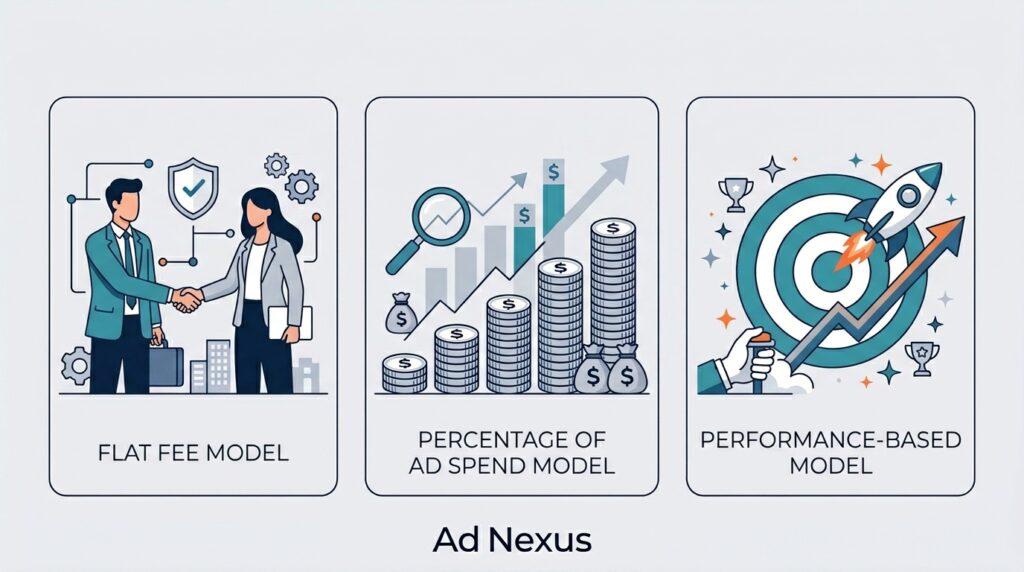
Three models dominate the market.
Percentage of ad spend is the most common. The agency takes 10–20% of whatever you spend on ads. If you spend £20,000/month, you pay £2,000–£4,000 in management fees on top. The problem? The agency’s income goes up when your spend goes up, not necessarily when your results improve.
Flat monthly retainer removes that conflict. You pay a fixed fee typically £500–£3,000/month for SMEs regardless of spend. This works well when budgets are stable and the scope of work is clearly defined.
Performance-based pricing ties fees to outcomes cost per lead, ROAS targets, or a percentage of attributed revenue. Sounds ideal. But it introduces disputes over attribution, especially with longer sales cycles.
Quick note: most reputable agencies combine a flat base retainer with a percentage above a spend threshold. That’s a fair middle ground it protects you from fee inflation at low spend, and compensates the agency fairly at high spend.
Quick Comparison Google Ads Agency Pricing Models
| Pricing Model | Best For | Key Benefit | Limitation |
| Percentage of ad spend | Growing accounts with rising budgets | Scales with campaign size | Incentivises overspending |
| Flat monthly retainer | Stable SME budgets, defined scope | Predictable cost, no conflict of interest | May not scale with workload |
| Performance-based | Lead-gen businesses with trackable conversions | Fee tied to results | Attribution disputes, harder to find |
| Hybrid (flat + %) | Mid-market accounts £5k–£50k/month | Balanced incentives | Requires clear contract terms |
Red Flags That an Agency Is Wrong for You
Some experts argue that Google Partner status is a reliable quality filter. That’s valid for a baseline check that confirms the agency meets minimum spend thresholds and has certified staff. But if you’re dealing with a firm that relies on Partner status as its primary credential, that’s worth scrutinising. The badge is a floor, not a ceiling.
Watch for these specific warning signs.
They can’t explain your Quality Score. Quality Score affects how much you pay per click and where your ads appear. An agency that glosses over it or blames Google doesn’t understand the lever they’re supposedly pulling.
Reporting is impressions and clicks only. Clicks are inputs. Conversions, cost per acquisition, and ROAS are outputs. If monthly reports lead with vanity metrics, your budget is probably funding their good-looking dashboards.
No mention of conversion tracking setup. This one’s critical. Without accurate conversion tracking ideally via Google Tag Manager connected to your CRM the agency is optimising blind. Every recommendation they make is based on incomplete data.
They promise page-one rankings. That’s SEO language, not PPC language. A Google Ads agency controls ad position through bid strategy and Quality Score. Confusing the two is a competency flag.
Look, if you’re evaluating an agency and they can’t tell you what your current impression share is, or why your search terms report matters, walk away.How to audit your Google Ads account? That’s not gatekeeping, it’s a basic functional expectation.
What a Realistic Onboarding Timeline Looks Like
This is the anxiety question that almost no agency answers publicly. You’re about to hand over the budget and access and you don’t know when you’ll see anything.
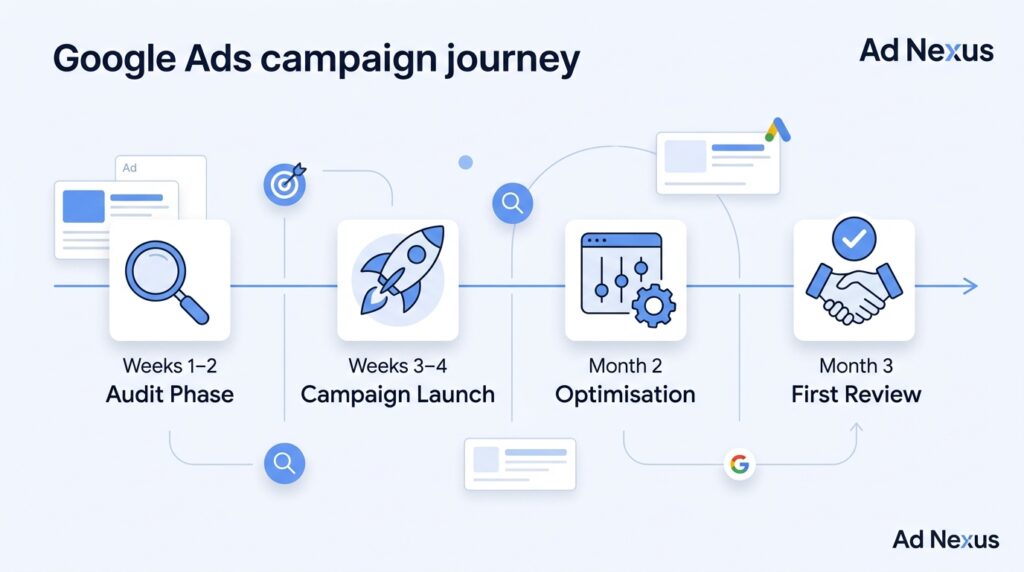
Here’s what an honest timeline looks like for a professionally managed account.
Weeks 1–2: Account audit, tracking verification, keyword research, campaign architecture planning. No new campaigns running yet. This phase matters more than most clients realise bad structure compounds into wasted spend for months.
Weeks 3–4: Campaign build, ad copy creation, conversion tracking validated end-to-end. Soft launch with conservative bids to gather initial data.
Month 2: Bidding strategies shift from manual CPC to smart bidding as conversion data accumulates. Search terms reports reviewed weekly. Negative keyword lists built aggressively.
Month 3: First meaningful performance data available. ROAS benchmarks start to stabilise. This is the earliest point where a fair performance review makes sense.
To choose a Google Ads management agency effectively, follow these steps:
- Request a full account audit before signing anything.
- Confirm conversion tracking is set up and verified not just promised.
- Ask for a 90-day onboarding plan in writing.
- Clarify who owns the Google Ads account if you leave.
- Review sample reports to confirm they show conversion data, not just clicks.
That last point about account ownership is non-negotiable. Your Google Ads account and its historical data should be under your Google account, not the agency’s MCC. Switching agencies without owning your data means starting from zero.
Small Business vs. Larger SME: Does Agency Size Matter?
Most people assume bigger agencies deliver better results. The data suggests otherwise or at least, it’s more nuanced than that.
Large agencies run more accounts. More accounts often means more junior account managers, templated campaign structures, and less time per client. A boutique agency handling 15–20 clients may give your account more strategic attention than a 200-person firm where you’re account number 847.
I’ve seen conflicting takes on this some industry voices argue that larger agencies have better tooling and more sophisticated testing frameworks. That’s true in some cases. But tooling advantage only matters if someone experienced is operating the tools. My read is that agency size matters less than the seniority of the person actually managing your account day-to-day.
Flat fee vs. percentage of spend: For small businesses spending under £5,000/month on ads, a percentage-of-spend model often doesn’t make economic sense for the agency and can result in deprioritisation. How to brief a PPC agency? A flat retainer model is typically a better fit at this budget level.
The question to ask on any discovery call: Who specifically will manage my account, and how many accounts do they run? If the answer is vague, or if it’s clearly a senior salesperson who’ll hand you to a junior team post-signature, factor that into your decision.
FAQs
Q: What’s the best type of Google Ads agency for a small business?
A: A boutique or specialist agency with a flat monthly retainer model, ideally one that manages fewer than 25 accounts per manager. Avoid agencies where you’re a small fish your account won’t get attention.
Q: How do I know if my Google Ads agency is doing a good job?
A: Check whether reports show conversion data, cost per acquisition, and ROAS not just clicks and impressions. A good agency explains what changed, why, and what comes next.
Q: Should I own my Google Ads account or let the agency manage it under theirs?
A: Always own your account. Your data, campaign history, and audience lists live in that account. If you leave the agency and they own it, you start from scratch.
Q: Why does my Google Ads campaign cost so much with so few results?
A: Poor account structure, untargeted keywords, and missing negative keyword lists are the most common causes. Without conversion tracking, the algorithm optimises for the wrong signals spending your budget on clicks that never convert.
Q: When should I expect results from a new Google Ads agency?
A: Realistically, allow 90 days. The first month is audit and setup, the second month is early data gathering, and month three is the first point where performance patterns become meaningful.
What most guides skip is this: the question isn’t just which agency is best, it’s which agency is right for your account size, industry, and internal capacity to collaborate. An agency that’s brilliant for an e-commerce brand may be a poor fit for a professional services firm with a 3-month sales cycle.