
If you’ve searched this before, you’ve probably landed on articles that quote a range so wide it’s useless. £0.10 to £15 per click. Thanks. Very helpful.
Here’s what this article does instead: it gives you real UK-specific figures by industry, explains the mechanics that make your cost go up or down, and this part most articles skip entirely shows you what a realistic total monthly investment looks like once you factor in management fees alongside ad spend.
What Ad Cost on Google Actually Means
Ad cost on Google refers to the amount an advertiser pays each time a user clicks their ad, known as cost-per-click (CPC). In the UK, this figure is set through a real-time auction and varies based on industry competition, keyword intent, and ad quality. There is no flat rate, every click is priced individually.
The auction runs every single time someone searches. Google doesn’t just sell to the highest bidder it factors in your Quality Score (a rating of how relevant your ad and landing page are) alongside your bid. A well-structured campaign can legitimately beat a competitor paying twice as much per click.
Or maybe I should say it this way: you’re not buying clicks at a fixed price. You’re competing for them, and how well you compete determines what you pay.
What Is the Average Ad Cost on Google in the UK?
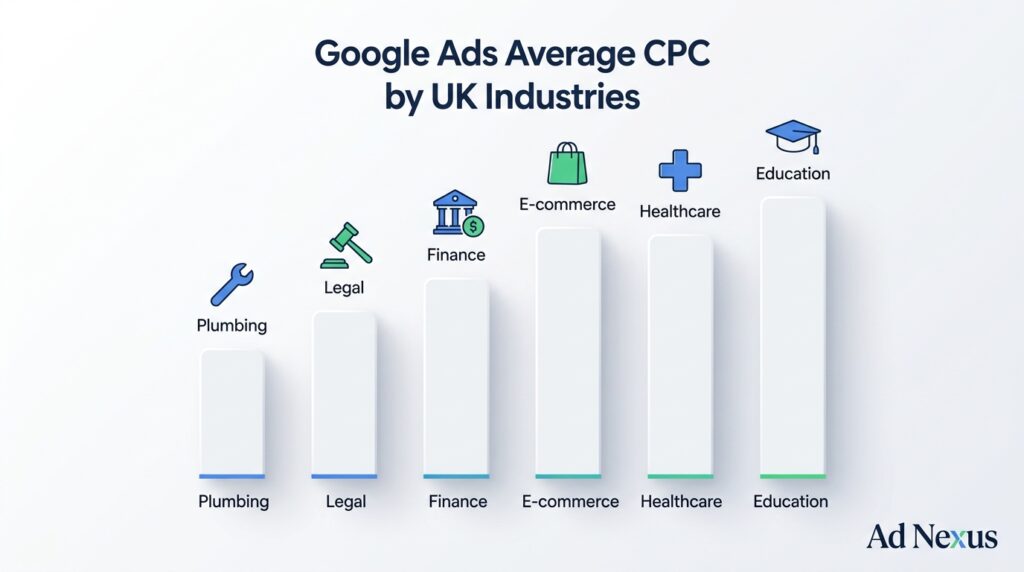
According to WordStream’s 2024 Google Ads Benchmarks report, the average CPC across all industries on Google Search is approximately £1.96 in the UK. But that average masks enormous variation.
A local plumber and a personal injury solicitor are both running Google Ads. The plumber might pay £1.20 per click. The solicitor could easily pay £12–£18. Same platform. Same auction mechanism. Completely different reality.
Here’s the thing: averages are useful for context, not budgeting. What matters is where your industry sits.
UK Google Ads CPC by Industry 2026 Benchmarks
Quick Comparison Table
| Industry | Avg. CPC (UK) | Best For | Key Limitation |
| Legal & Financial | £8 – £18 | High-value leads with large LTV | Extremely competitive; needs tight targeting |
| Home Services (plumbing, electrical) | £1.50 – £4.00 | Local intent, fast buyer decisions | Geographic targeting must be precise |
| E-commerce (retail) | £0.50 – £2.50 | Volume-driven product sales | Thin margins demand low CPC discipline |
| Healthcare & Dental | £2.00 – £6.00 | Appointment-based conversions | Restricted ad policies apply |
| Education & Training | £1.80 – £5.00 | Lead gen for courses/qualifications | Long decision cycles reduce conversion rate |
| B2B / SaaS | £3.00 – £9.00 | High-intent decision makers | Low search volume; quality matters more than quantity |
Sources: WordStream 2024 Benchmarks, SEMrush UK industry CPC data, Google Ads Keyword Planner estimates all figures converted to GBP and adjusted for UK market conditions.
Why Your Actual Cost Per Click Will Differ From the Average
Most articles stop at here’s the average CPC. That’s where the real explanation should begin.
Three things directly control what you pay per click:
1. Quality Score
Google assigns every keyword a Quality Score from 1–10 based on expected click-through rate, ad relevance, and landing page experience. A score of 8 on a competitive keyword can cost you 30–50% less per click than a competitor with a score of 4 even if they’re bidding higher. This is the single most misunderstood lever in Google Ads.
2. Competition in your auction
The more advertisers bidding on a keyword, the higher the floor price rises. Solicitor London has dozens of firms competing. Solicitor Shrewsbury has three. Same service. Very different CPC.
3. Match type and keyword intent
Broad match keywords attract more impressions but often lower-quality traffic. Exact match tends to cost more per click but converts better. Getting this balance right takes testing; there’s no universal answer.
Quick note: Google’s own documentation confirms that Ad Rank (which determines your position and cost) is calculated as: Bid × Quality Score × context signals. Bid alone doesn’t win auctions.
How Much Should a UK Small Business Budget for Google Ads Per Month?
This is where most guides go vague. Let’s be direct.
Small businesses asking about ad cost on Google typically need a minimum monthly spend of £500–£1,000 just in ad budget to gather statistically meaningful data. According to WordStream’s 2024 benchmarks, campaigns with budgets below £300/month in competitive UK niches rarely generate enough clicks to optimise effectively. The sweet spot for most local service businesses is £800–£2,000/month in pure ad spend.
What ad spend doesn’t include:
This is the gap neither competitor article addresses directly. Your ad spend is what goes to Google. But most businesses also need someone to manage the campaign and that’s a separate cost.
Realistic total monthly investment for a UK small business:
| Component | Typical Range |
| Google Ads spend (clicks) | £500 – £3,000/month |
| Agency management fee | £300 – £800/month |
| Landing page / CRO work (one-off or monthly) | £200 – £500 |
| Total realistic investment | £1,000 – £4,300/month |
I’ve seen conflicting data on management fee benchmarks, some sources say 10–15% of ad spend, others quote flat fees starting at £250. My read is this: flat fees make more sense for small accounts (under £2,000 spend), percentage models benefit the agency more than the client on larger budgets unless tied to performance.
That’s an opinion some agency owners will push back on. But from a client’s standpoint, paying £600/month to manage a £600/month ad budget means your management overhead just doubled your effective cost per click. That maths matters.
How to Estimate Your Google Ads Cost Before You Spend Anything
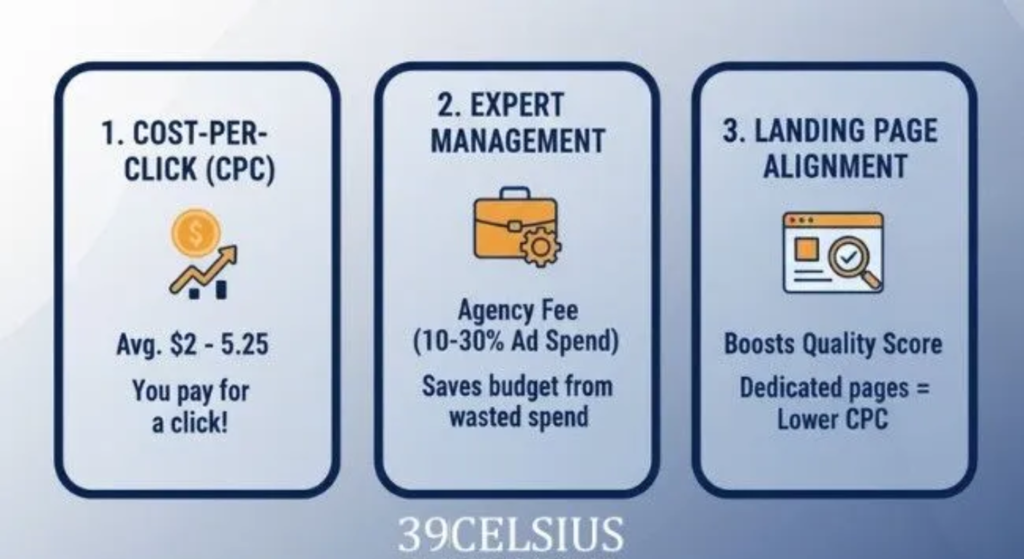
To estimate your Google Ads cost before launching, follow these steps:
- Open Google Ads Keyword Planner and enter your target keywords
- Filter results by UK location and check the suggested bid range
- Multiply your estimated CPC by the clicks needed to generate one lead
- Add your target number of leads per month to calculate minimum monthly spend
- Factor in a 15–20% buffer for bid adjustments during the first 60 days
Three tools worth using before you commit a penny:
Google Ads Keyword Planner: Free inside your Google Ads account. Shows estimated CPC ranges for any keyword in any UK region. Not perfectly accurate, but close enough to sanity-check a budget.
SEMrush: Paid tool, but the CPC data is more granular than Keyword Planner, especially for competitive niches. You can see what competitors are actually bidding on, not just what Google suggests.
Google’s Performance Planner: Available once your campaign has some historical data. It forecasts what increasing or decreasing your budget will do to clicks, conversions, and cost. Genuinely useful for scaling decisions.
Look, if you’re in a service business with an average client value above £500, here’s what actually works: start with a tightly geo-targeted campaign, 10–15 exact-match keywords, a budget of £800–£1,200/month, and measure cost per lead not cost per click. A £4 click that converts at 15% is better than a £1 click that converts at 2%.
The Hidden Costs Most UK Businesses Don’t Account For
Beyond the click cost itself, UK businesses running Google Ads face several indirect costs that affect total ROI. According to Google’s own support documentation, campaigns without dedicated landing pages convert at roughly half the rate of campaigns with purpose-built pages. This means a business spending £1,000/month on clicks but sending traffic to their homepage may need to double their budget to achieve the same lead volume as a competitor with optimised landing pages.
What gets forgotten:
Wasted spend from poorly structured campaigns. Google’s default settings favour broad match and Smart campaigns both of which spend aggressively, sometimes on irrelevant searches. Without negative keywords and regular search term reviews, 20–40% of ad spend can go to clicks that will never convert.
Conversion tracking setup. If you don’t have this correctly configured, you’re flying blind. You’ll know what you spent. You won’t know what it produced.
The learning period. New campaigns take 4–8 weeks to stabilise. During that time, CPC is often higher and conversion rates are lower. Budget for a learning phase it’s not failure, it’s how the algorithm works.
Most people assume Google Ads works immediately. The data says otherwise most campaigns hit their performance ceiling around weeks 6–10 after proper optimisation, not week one.
Google Ads Cost vs. Other Paid Channels Is It Worth It?
Some experts argue that Meta Ads (Facebook/Instagram) deliver better ROI for UK small businesses because CPCs are lower and audience targeting is more granular. That’s valid for awareness-stage campaigns and e-commerce with visual products. But if you’re dealing with high-intent, service-based searches, someone typing emergency boiler repair London at 9pm Google Ads has no real competitor. The intent is already there. You’re not creating demand, you’re capturing it.
Google Ads vs. Meta Ads: Google is better suited for high-intent, service-based searches because users are actively looking to buy or hire. Meta Ads work better when building awareness or targeting specific demographic profiles. The key difference is that Google captures existing demand, Meta creates new demand.
When comparing ad cost on Google to other platforms, Google Search typically shows higher CPCs than Meta or LinkedIn but delivers higher purchase intent. For UK service businesses, Google’s average conversion rate of 3.75% (WordStream, 2024) outperforms Meta’s typical 1–2% for lead generation. The higher click cost is often offset by a lower cost per qualified lead.
FAQs
Q: What’s the average cost per click on Google Ads in the UK?
A: According to WordStream’s 2024 data, the average CPC in the UK is around £1.96 across all industries. Legal and financial sectors regularly exceed £8–£15 per click due to high competition.
Q: How much should I spend on Google Ads per month as a small business?
A: A realistic starting budget for UK small businesses is £800–£1,500/month in ad spend. Add agency management fees if you’re outsourcing, which typically run £300–£800/month on top of that.
Q: Why does my Google Ads cost keep going up?
A: Rising CPCs usually mean increased competitor activity in your auction, a drop in Quality Score, or broader match types pulling in unintended searches. Check your search term report and Quality Score first.
Q: Should I manage Google Ads myself or hire an agency?
A: DIY works for budgets under £500/month if you have time to learn the platform. Above that, poor campaign structure typically wastes more than an agency fee costs but vet the agency’s reporting carefully.
Q: When does Google Ads stop being worth the cost?
A: When your cost per acquired customer exceeds your customer lifetime value, or when conversion tracking shows clicks but no leads meaning the landing page or offer is the problem, not the ad itself.
This guide covers standard Google Search campaigns for UK businesses. It does not address Google Shopping, Performance Max attribution complexity, or VAT implications on ad spend for businesses under the registration threshold.