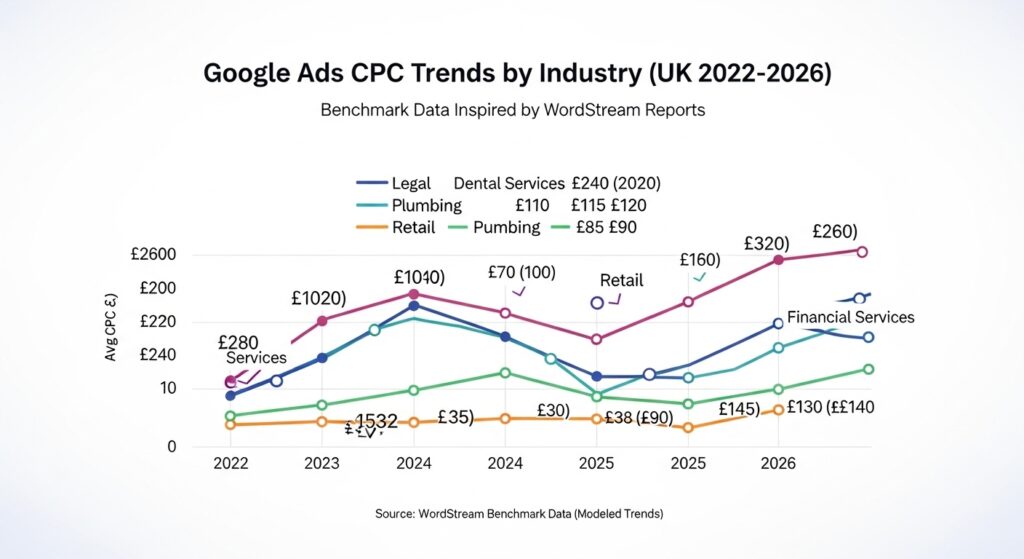
Your CPC didn’t spike overnight. It crept up 8% one month, 12% the next until suddenly your boss is asking why the same budget is delivering fewer clicks than it did six months ago.
Google’s auction has gotten more competitive, AI-driven match expansion has widened what triggers your ads, and most optimization checklists still teach 2022 techniques.
Every tactic here accounts for where the platform actually is in 2026 including AI Max campaigns, smart bidding edge cases, and the compounding Quality Score relationship that most articles mention once and never explain properly.
What does reducing Google Ads CPC actually mean?
Reducing Google Ads CPC (cost-per-click) means lowering the average amount you pay each time someone clicks your ad, without sacrificing click volume or conversion performance. It’s achieved through a combination of Quality Score improvement, smarter bidding configuration, tighter audience targeting, and eliminating wasted spend on irrelevant match expansions. The goal is paying less for the same or better traffic.
Why Your CPC Is Rising (And Why Generic Fixes Aren’t Working)
According to WordStream’s 2024 Google Ads Industry Benchmarks report, the average CPC across all industries on Google Search climbed to $4.66 with legal, finance, and insurance verticals regularly exceeding $8–$10 per click. That’s not a temporary spike. It reflects a structural shift in how Google’s auction prices inventory.
Here’s what’s actually happening beneath the surface:
Google’s move toward broad match defaults and AI-driven expansion means your ads are entering auctions they were never explicitly targeted for. You’re competing and paying in keyword spaces you didn’t choose. Meanwhile, smart bidding strategies like Target CPA optimize for conversion probability, not CPC efficiency, so they’ll happily let your CPC rise if the model predicts a conversion at the end of it.
Most guides tell you to improve your Quality Score. That’s true but incomplete.
The real mechanism is a compounding loop between three Quality Score sub-components: expected click-through rate (CTR), ad relevance, and landing page experience. When one is low, it drags the other two down in ways that aren’t visible in the interface. Fixing only your ad copy while leaving a slow, generic landing page is like patching one leak in a sinking boat.
Or maybe I should say it this way: Google is silently penalizing you on all three signals simultaneously, and most advertisers are only optimizing one.
The 10 Tactics: Ranked by Impact and Effort
Quick note:These aren’t listed alphabetically or by popularity. They’re ordered by the ratio of CPC reduction to implementation time highest leverage first.
Most guides tell you to write better ads. That’s step two.
1. Fix the Quality Score Triad Not Just One Component
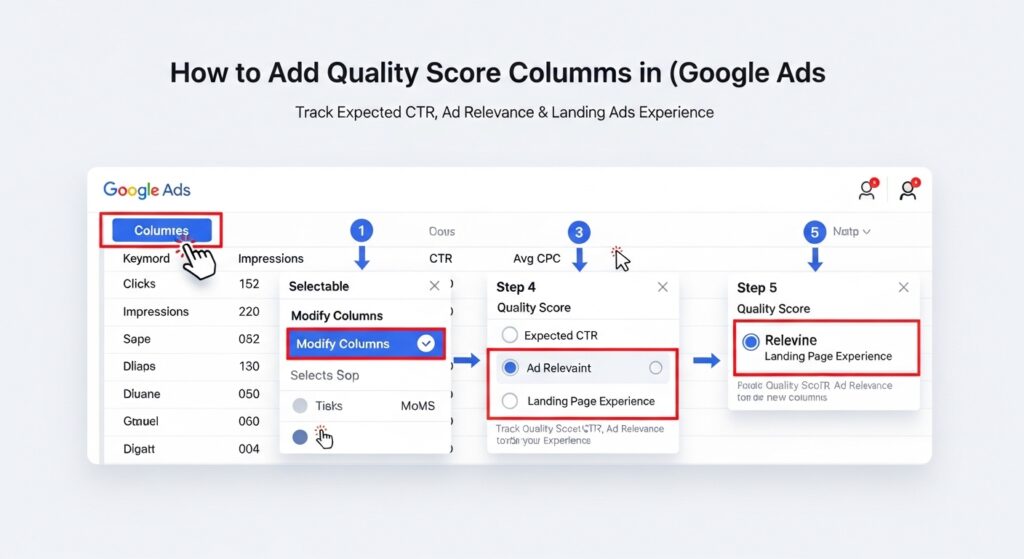
Step one is diagnosing which of the three sub-scores is actually dragging your Quality Score down. You can’t see this breakdown by default you have to add the columns manually in Google Ads (right-click any column header → Modify columns → Quality Score → add Expected CTR, Ad Relevance, and Landing Page Experience separately).
To improve Quality Score systematically, follow these steps:
- Pull Quality Score sub-component columns for all active keywords
- Identify keywords rated Below Average on any sub-component
- Fix landing page experience first (it affects all three scores)
- Rewrite ad copy to mirror the keyword’s exact search intent
- Group keywords by theme so ad relevance stays tight at the ad group level
Each point of Quality Score improvement reduces your CPC by approximately 16–50%, depending on your competitor density that’s not a marketing claim, that’s the mathematical output of Google’s Ad Rank formula, where Quality Score directly divides into your cost calculation.
Expected CTR is the highest-weighted sub-component. If yours is Below Average, your first move is testing new headlines, specifically ones that front-load the keyword and a specific benefit within the first 30 characters.
2. Control AI Max Campaign Behavior Before It Controls Your Budget
This is the tactic neither competitor article covers and in 2026, it’s arguably the most urgent one.
AI Max campaigns (Google’s successor to broad match + smart bidding combinations) use URL expansion and creative asset mixing to serve your ads across placements and queries that your original targeting wouldn’t have reached. On paper, that’s more reach. In practice, it often means paying elevated CPCs for traffic that converts at a fraction of your core keyword rate.
The two controls most advertisers leave untouched:
Custom URL rules AI Max can override your destination URLs to send traffic to what it predicts is the best page on your site. If your homepage has weaker conversion signals than your dedicated landing page, you’re paying search-level CPCs for homepage bounce rates. Lock your destination URLs at the asset group level under the URL expansion settings.
Without explicit exclusions, AI Max will sometimes bid on competitor brand queries or, worse, your own brand terms at non-brand CPCs. Add your brand as a brand exclusion within AI Max settings to prevent cannibalizing your own branded campaigns at inflated prices.
Look, if you inherited an account where AI Max is running without these controls configured, here’s what actually works: pause AI Max for 72 hours, review the search terms report for the prior 30 days, identify the top 20% of spend that came from queries you’d never have targeted manually, then re-enable with URL rules and brand exclusions set.
3. Rebuild Your Negative Keyword List With a Structured Audit
Adding a few negatives isn’t enough. That’s what you’ve already tried.
A structured negative keyword audit looks different. Using Google Ads Editor which allows bulk negative keyword management across campaigns simultaneously pull your search terms report for the last 90 days, filtered to any query with zero conversions and more than $10 in spend. That’s your starting list.
From there, layer by match type:
- Exact negatives for specific irrelevant queries (e.g., [free], [jobs], [DIY] if you’re a B2B service)
- Phrase negatives for intent-level mismatches (e.g., how to if you’re targeting buyers, not researchers)
- Broad negatives sparingly broad negatives are blunt instruments that can accidentally block converting traffic
I’ve seen conflicting data on how many negatives constitute enough some sources say 200+ is a healthy list, others argue that over-negating shrinks your reach and forces smart bidding into a smaller learning dataset, which can destabilize CPCs. My read: prioritize quality over quantity. Fifty highly targeted negatives will outperform 300 generic ones.
4. Shift Bidding Strategy Based on Campaign Maturity
This one trips up a lot of intermediate advertisers.
Target CPA and Target ROAS are not set-and-forget solutions. They’re optimization tools that require sufficient conversion data to function correctly Google’s own documentation specifies a minimum of 30 conversions in the past 30 days before smart bidding can optimize effectively. Below that threshold, the algorithm makes statistically unreliable decisions, and your CPC becomes erratic.
Quick Comparison: Bidding Strategies and CPC Control
| Strategy | Best For | Key Benefit | Limitation |
| Manual CPC | New campaigns, <30 conversions/month | Full price control | Labor-intensive, no automation |
| Enhanced CPC (eCPC) | Transitioning to automation | Partial automation with bid caps | Less effective since Google deprioritized it |
| Target CPA | Established campaigns, 30+ conv/month | Optimizes for cost per acquisition | Will raise CPC if it predicts conversions |
| Target ROAS | E-commerce, high conversion volume | Revenue-focused optimization | Requires rich conversion value data |
| Maximize Clicks | Brand awareness, traffic goals | Maximizes volume within budget | No CPC efficiency guarantee |
Label: Quick Comparison — Google Ads Bidding Strategies for CPC Control
If your campaign has fewer than 30 conversions monthly, Manual CPC with bid adjustments gives you more control and typically lower average CPCs than a Target CPA strategy that’s operating on insufficient data.
5. Tighten Ad Group Theming to One Core Concept
Broad ad groups kill CPC efficiency in a way that’s invisible until you look at the sub-score data.
When a single ad group contains 15–20 loosely related keywords, Google can’t consistently serve an ad that’s highly relevant to every query. Ad relevance drops. Quality Score drops. Your CPC rises to compensate for a lower Ad Rank.
The fix is Single Theme Ad Groups (STAGs) not to be confused with SKAGs (Single Keyword Ad Groups), which are largely obsolete with broad match expansion. STAGs group keywords by the same core search intent, not just the same root word.
For example: Google Ads management, hire Google Ads expert, and Google Ads agency near me belong in one STAG. Google Ads tips, how to reduce CPC, and Google Ads optimization guide belong in a completely different one even though they’re all Google Ads keywords.
The difference in search intent is what matters. Not the surface-level keyword similarity.
6. Use Audience Layering to Bid Down on Low-Intent Traffic
Some experts argue that audience bid adjustments are a minor optimization, a 5–10% efficiency gain at best. That’s valid for campaigns already targeting highly specific keywords. But if you’re running broad or phrase match at scale, audience layering becomes a primary CPC lever, not a secondary one.
Here’s how to implement it without shrinking reach:
Set your audience targeting to “Observation” mode (not Targeting that restricts reach). Then apply negative bid adjustments of -20% to -50% for audiences that correlate with low conversion rates: new visitors without site engagement, audience segments that bounce within 10 seconds based on Google Analytics data, or demographic segments your conversion data shows never convert.
You’re not blocking them. You’re just paying less when they click.
7. Improve Landing Page Experience Scores Directly
Your landing page experience score isn’t just an SEO metric. It’s a direct CPC input.
Google evaluates three things when scoring landing page experience: relevance to the ad and keyword, mobile usability, and page load speed. A Below Average landing page score can inflate your CPC by 30–50% compared to an Above Average score on equivalent keywords because your Ad Rank suffers on every single auction you enter.
The fastest wins:
- Mobile load speed: Use Google PageSpeed Insights (free) to identify Core Web Vitals failures. A landing page loading in under 2.5 seconds on mobile gets materially better scores than one loading in 4+ seconds
- Keyword mirroring: The headline on your landing page should contain or closely reflect the primary keyword in your ad. Google’s relevance scoring reads your page content a generic homepage fails this test every time
- Conversion signals above the fold: A clear CTA, trust indicators (reviews, certifications), and a specific value proposition all visible without scrolling correlate with better engagement signals that feed back into landing page experience scores
Tools like Optmyzr can automate landing page Quality Score monitoring across large accounts, flagging ad groups where the landing page score drops and triggering alerts before the CPC impact compounds.
8. Leverage Ad Schedule and Device Bid Adjustments
Raw CPC data across your account masks significant variance by time of day, day of week, and device type.
Pull a Time of Day report in Google Ads (Reports → Predefined Reports → Time → Hour of Day). You’ll almost always find that certain time windows have CPCs 40–80% higher than your account average often without proportionally higher conversion rates. Applying -30% bid adjustments during those windows doesn’t reduce your ad visibility significantly during low-competition hours; it stops you overpaying during high-auction-pressure periods.
Device-level data tells a similar story. If mobile traffic converts at half the rate of desktop but carries the same CPC, a -30% mobile bid adjustment immediately improves your effective CPA and frees budget for higher-performing placements.
What most guides skip: check device performance by campaign type separately. Performance Max campaigns often skew heavily toward mobile placements, while Search campaigns may show the opposite pattern. Applying a blanket device adjustment across all campaign types is a blunt correction that can misfire.
9. Run Competitor Ad Intelligence Before Increasing Bids
Reflexively raising bids when your CPC spikes is one of the most expensive mistakes in paid search. Sometimes you’re in a legitimate auction war with a well-funded competitor. Sometimes a single competitor ran a budget surge for two weeks and it’s already over.
Tools like SEMrush or Ahrefs give you competitor ad history, showing when competitors entered or exited specific keyword auctions, their approximate budget changes, and which ad copies they’re currently testing. If a competitor spiked their bids for a two-week product launch and you responded by permanently raising your bids, you’re now paying their promotional tax indefinitely.
Before adjusting bids upward on any keyword segment, run a 30-day competitor audit. Check if the CPC pressure is structural (a new major competitor) or temporary (a campaign blitz). The response is completely different.
10. Restructure Campaigns Around Funnel Stage, Not Just Keywords
This is a structural change, not a quick win but it’s the one that compounds all the other tactics above.
Most self-managed accounts lump awareness, consideration, and purchase-intent keywords into the same campaigns with the same bidding strategy and the same CPC targets. That’s why CPC optimization feels like a whack-a-mole game. You fix it in one place and it reappears in another.
A funnel-staged campaign structure separates traffic by intent level:
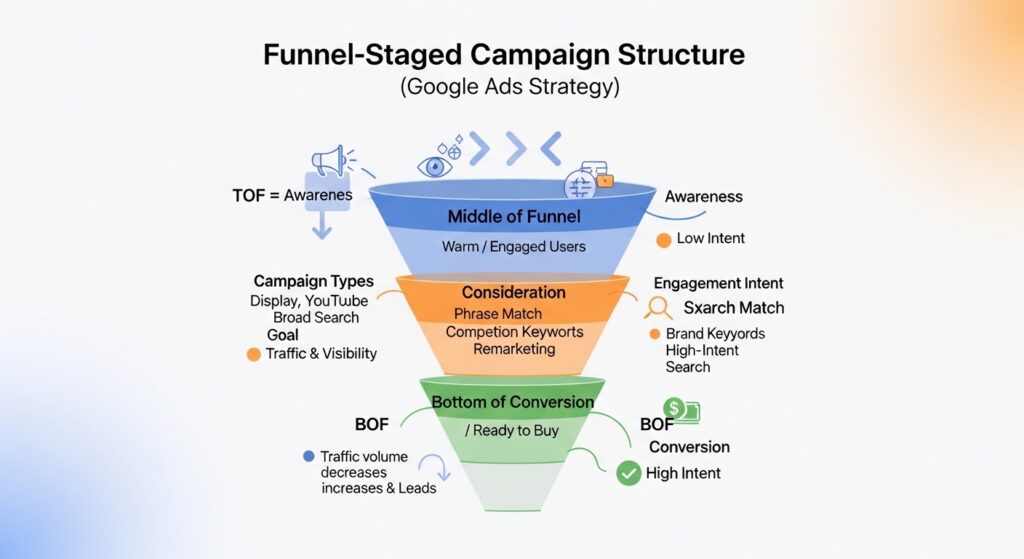
- Top-of-funnel (TOF): Educational keywords, low bids, maximize clicks strategy, CPC cap set manually
- Middle-of-funnel (MOF): Comparison keywords, Target CPA with conservative targets, retargeting audiences layered in
- Bottom-of-funnel (BOF): High-intent keywords, aggressive Target ROAS or Target CPA, tightest ad groups, best landing pages
When each funnel stage has its own CPC targets and bidding logic, you stop letting a high-volume TOF keyword inflate the average CPC across a campaign that also contains your highest-converting BOF terms.
This is the architecture that makes every other optimization on this list more effective.
FAQs
Q: What’s the best way to lower CPC in Google Ads without reducing traffic volume?
A: Improve your Quality Score specifically landing page experience and expected CTR. A higher Quality Score lowers the CPC you pay per auction without changing your bid or reducing your ad’s eligibility to show.
Q: How do I stop AI Max campaigns from inflating my CPC?
A: Enable custom URL rules to lock destination pages and add brand exclusions in AI Max settings. This prevents the algorithm from bidding on irrelevant placements and cannibalizing your own branded campaigns at non-brand CPCs.
Q: Should I use Target CPA or Manual CPC to reduce cost per click?
A: Use Manual CPC if your campaign has fewer than 30 conversions per month. Target CPA requires sufficient data to function below that threshold, it makes unreliable decisions that often raise CPC without improving conversion rates.
Q: Why does my CPC keep rising even after adding negative keywords?
A: Negative keywords reduce wasted clicks but don’t directly lower CPC in competitive auctions. If your Quality Score sub-components, especially expected CTR and landing page experience are rated Below Average, you’re paying a premium on every auction regardless of how clean your keyword list is.
Q: When should I use audience bid adjustments to control CPC?
A: Use audience bid adjustments in Observation mode when your campaign-level data shows specific segments (by device, demographic, or behavior) consistently converting at lower rates. Apply negative adjustments of -20% to -50% to those segments to reduce what you pay when lower-intent users click.
Conclusion
This guide covers CPC optimization within existing Google Ads campaigns. It does not address: industry-level CPC inflation caused by seasonal advertiser volume increases (which temporarily raise all auction prices regardless of optimization), CPC issues rooted in Google Merchant Center feed quality for Shopping campaigns, or accounts with fewer than 90 days of conversion data where smart bidding has no reliable baseline.
If your account is brand new or you’ve recently changed your conversion tracking setup, resolve the data integrity issues before applying any bidding-level tactics the algorithm can’t optimize what it can’t measure.