Most PPC guides tell you what pay per click is. This one tells you why your campaign isn’t working and exactly how to fix it.
According to Google’s Economic Impact data (2023), businesses earn an average of $2 for every $1 spent on Google Ads. That’s the headline. But that average includes thousands of well-structured campaigns pulling that number up and just as many poorly built ones dragging it down. Which side you land on comes down to structure, not spend.
What Pay Per Click Campaigns Actually Are (And What Most People Get Wrong)
Pay per click campaigns are digital advertising campaigns where you pay a fee each time a user clicks your ad, rather than paying for impressions or reach. The most common platform is Google Ads, where your ads appear in search results when someone types a query that matches your target keywords.
That definition is simple. The execution is not.
Here’s what most first-time advertisers misunderstand: you’re not buying clicks. You’re entering an auction every single time someone searches. Google’s algorithm determines your ad position using a combination of your bid, your Quality Score, and your expected impact. Bid highest and still lose the top spot. It happens constantly.
Quality Score is a 1–10 rating Google assigns based on expected click-through rate, ad relevance, and landing page experience. A higher Quality Score means you pay less per click for better placement. Users who’ve ignored Quality Score and focused only on raising bids often report paying 2–3x more per click than competitors with tighter, more relevant ad groups.
Quick note: That’s not a minor inefficiency. On a $2,000/month budget, paying $4 per click instead of $2 cuts your traffic in half before a single conversion happens.
How the PPC Auction Works The Part Nobody Explains Clearly
Understanding the auction is the single biggest lever most small advertisers never pull.
When someone searches for an emergency plumber in Chicago, Google runs an auction in milliseconds. Every advertiser targeting that query submits an effective bid. Google then calculates Ad Rank for each advertiser using this formula:
Ad Rank = Bid × Quality Score × Expected Ad Extensions Impact
You win a position based on Ad Rank not raw bid. An advertiser bidding $3 with a Quality Score of 9 can outrank an advertiser bidding $8 with a Quality Score of 3.
Or maybe I should say it this way: the quality of your keyword-to-ad-to-landing-page match matters more than your budget. This is the counter-intuitive truth that changes how serious advertisers approach campaign builds.
According to WordStream’s PPC benchmarking data, the average Quality Score across all industries sits between 5 and 6. Advertisers who push their scores to 7 or above consistently see cost-per-click drop by 16–50% depending on the competitive landscape of their niche.
How PPC auctions determine ad position:
Google’s ad auction calculates Ad Rank using your maximum bid, Quality Score, and expected extension impact. According to Google’s own documentation, a higher Quality Score directly lowers your cost per click and raises your position meaning ad relevance and landing page quality are as important as how much you bid.
How to Build a Pay Per Click Campaign From Scratch (The Right Structure)
This is where most guides skip the hard part. Structure determines everything downstream your Quality Score, your conversion rate, your cost per click. Get it wrong at this stage and no amount of bid adjustment fixes it.
To set up a pay per click campaign correctly, follow these steps:
- Define one goal per campaign leads, sales, or phone calls. Never mix objectives.
- Research keywords using Google Keyword Planner or SEMrush target 15–30 high-intent terms per ad group.
- Organize ad groups by theme one tight topic per group, not one massive group with 200 keywords.
- Write 3 responsive search ad variations per ad group test headlines against each other, not campaigns against each other.
- Build a dedicated landing page per ad group and never send PPC traffic to your homepage.
- Install conversion tracking before spending a dollar Google Tag Manager + Google Ads conversion action.
- Add 15–20 negative keywords before launch block irrelevant traffic from day one.
Each step matters. But steps 5, 6, and 7 are where most people’s campaigns are silently hemorrhaging budget right now.
Look, if you’re running ads and sending traffic to your homepage, here’s what actually works instead: create a standalone landing page that mirrors the exact language in your ad headline. Match the keyword intent. Remove navigation menus. Add one clear call to action. That single change routinely lifts conversion rates by 30–80% in A/B tests across lead-gen industries.
PPC Bidding Strategies: Which One to Use at Each Stage
Choosing the wrong bidding strategy wastes money even when everything else is right. Here’s how to match strategy to campaign maturity.
Quick Comparison
| Strategy | Best For | Key Benefit | Limitation |
| Manual CPC | New campaigns (0–30 days) | Full control over individual keyword bids | Time-intensive; requires constant monitoring |
| Maximize Clicks | Early traffic building | Gets data fast at lowest CPCs | Doesn’t optimize for conversions |
| Target CPA | Campaigns with 30+ conversions/month | Automates bids toward a cost-per-acquisition goal | Needs conversion history to work effectively |
| Target ROAS | E-commerce with clear revenue data | Optimizes for return on ad spend in real time | Requires accurate revenue tracking and volume |
| Maximize Conversions | Scaling proven campaigns | Google’s Smart Bidding at its most aggressive | Can spike CPCs if budget cap is too low |
Some experts argue that Smart Bidding should replace manual strategies as soon as possible. That’s valid for accounts with clean conversion data and sufficient volume. But if you’re dealing with a new campaign under 30 days old with fewer than 20 conversions recorded, Smart Bidding has nothing to learn from and it will overspend while it figures things out.
Start manual. Let data accumulate. Switch to Target CPA once you hit 30 verified conversions in a 30-day window. That’s the actual recommended threshold in Google’s own Smart Bidding documentation.
Which PPC bidding strategy should beginners use:
New PPC campaigns should start with Manual CPC bidding to maintain control while gathering data. According to Google Ads Help documentation, Smart Bidding strategies like Target CPA perform best after a campaign has recorded at least 30 conversions in a 30-day period. Switching too early typically results in erratic CPCs and wasted spend.
Negative Keywords: The Most Underused Tool in PPC Campaign Management
Stop skipping this section. Negative keywords are where budget leaks.
A negative keyword tells Google: don’t show my ad for this search. If you sell premium leather sofas and someone searches for cheap leather sofa DIY, that click costs you money and converts at near zero. Adding cheap and DIY as negative keywords blocks that traffic before it hits your account.
Most new advertisers add zero negative keywords before launch. WordStream’s research found that accounts actively using negative keyword lists reduce wasted spend by up to 20% within the first 90 days.
Here’s a practical negative keyword starter list for a service business:
- free
- jobs / careers / hiring
- DIY / how to make / tutorial
- reviews (unless you have a dedicated review landing page)
- [competitor brand names] (unless you’re running a competitor campaign intentionally)
Build a master negative keyword list at the account level. Apply campaign-specific negatives on top. Review your Search Terms report weekly for the first 60 days. That’s where Google shows you exactly what people actually typed before clicking your ad.
How to Read Your Campaign Data and Actually Know What to Fix
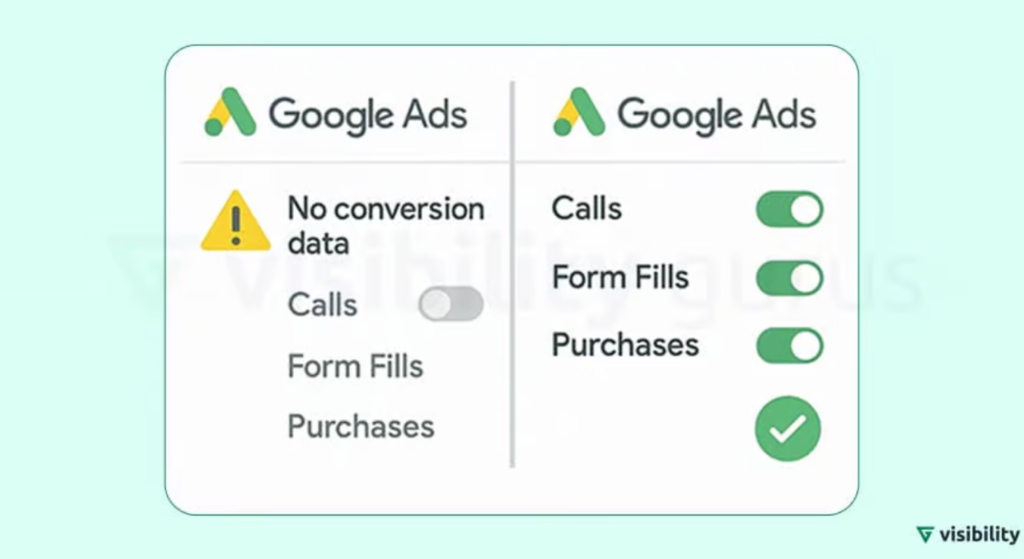
Data without interpretation is noise.
The three numbers that tell you whether a campaign is working are CTR (click-through rate), conversion rate, and cost per conversion. Everything else is context.
CTR benchmarks by industry (WordStream, 2024): Average CTR across all industries on Google Search is 6.11%. If yours is below 3%, your ad copy isn’t resonating with the search query to tighten your headlines. If your CTR is strong but conversion rate is low (industry average: 4.4% for Google Ads), the problem is your landing page, not your ads.
I’ve seen conflicting data on this; some sources cite average conversion rates as high as 7–8% for top-quartile accounts, while others peg the median closer to 3.5%. My read is that conversion rate benchmarks vary so much by industry and offer type that the only useful comparison is your own account’s trend over time.
Cost per conversion is your north star. Calculate it weekly. If it’s rising without a corresponding increase in lead quality or revenue, something in the funnel broke.
What most guides skip is this: don’t optimize campaigns in the first 7 days. Google’s algorithm needs time to exit the learning phase typically 5–7 days after a significant change. Making bid adjustments or pausing keywords daily during this window resets the learning phase and locks you in a cycle of perpetually incomplete data.
How to tell if a PPC campaign is performing well:
A healthy pay per click campaign shows a click-through rate above 6% on Google Search, a conversion rate above 4%, and a cost per conversion that stays flat or declines as the campaign matures. If CTR is strong but conversions are low, the issue is typically the landing page not the ads or keywords.
FAQs
Q: What’s the best bidding strategy for a new pay per click campaign?
A: Start with Manual CPC to maintain control while your campaign collects data. Switch to Target CPA once you’ve recorded at least 30 conversions in 30 days. Smart Bidding works best with a solid conversion history behind it.
Q: How do I lower my cost per click on Google Ads?
A: Improve your Quality Score. Higher ad relevance, stronger expected CTR, and a better landing page experience all reduce what Google charges per click sometimes by 30–50% compared to low-scoring competitors bidding higher.
Q: Should I use broad match or exact match keywords in PPC?
A: Use exact match for your highest-converting, clearest-intent keywords. Use phrase match for mid-funnel discovery. Avoid broad matches until you have strong negative keyword lists in place. It burns the budget fast on irrelevant queries.
Q: Why does my PPC campaign get clicks but no conversions?
A: Usually a landing page mismatch. Your ad promises something the landing page doesn’t immediately deliver: different headline, different offer, or no clear call to action above the fold. Match your ad language to your page headline exactly.
Q: When should I pause a keyword in a PPC campaign?
A: Pause a keyword when it’s spent 3–5x your target cost per conversion with zero conversions, or when its Quality Score stays at 3 or below after 30+ days of data. Don’t pause based on impressions or clicks alone.
This guide covers Google Ads search campaigns for small-to-mid advertising budgets. It does not address Shopping campaigns, Performance Max, or advanced audience layering strategies those warrant their own dedicated walkthroughs.