If your Google Ads account is running but your pipeline isn’t growing, the problem is almost certainly not your budget. It’s what’s happening or not happening inside the account every week.
Pay per click management services exist to fix exactly that.
What Are Pay Per Click Management Services?
Pay per click management services refers to the ongoing strategic oversight of paid search campaigns including keyword targeting, bid management, ad copy testing, Quality Score improvement, and conversion tracking carried out by a specialist agency or consultant on behalf of a business.
It is not a one-time setup. That distinction matters more than most people realise.
A managed PPC service covers the full campaign lifecycle: building the account structure, selecting and refining keywords, writing and testing ad variations, adjusting bids based on performance data, and reporting on what’s working. The goal is not just clicks, it’s qualified clicks that convert at a profitable cost.
According to Google’s own Economic Impact Report (2023), businesses earn an average of $2 for every $1 spent on Google Ads. That figure assumes active management. Unmanaged or poorly structured campaigns routinely produce the opposite result.
What a PPC Manager Actually Does Week to Week
Most business owners picture PPC management as someone occasionally logging into Google Ads and pressing a few buttons. That’s not it.
Here’s what active management looks like in practice:
- Negative keyword reviews: cutting search terms that trigger ads irrelevantly and drain budget
- Bid adjustments: raising or lowering bids by device, location, time of day, and audience segment
- Ad copy testing: running A/B variants on headlines and descriptions to improve click-through rate
- Quality Score monitoring: improving ad relevance and landing page alignment to reduce CPC
- Conversion tracking audits: making sure the data feeding into your bidding strategy is actually accurate
- Search term report analysis: finding new keyword opportunities and match type refinements
Quick note: Quality Score directly affects how much you pay per click. A score of 8/10 vs 4/10 on the same keyword can mean a 30–50% difference in CPC. Most self-managed accounts never touch it.
In-House vs Freelancer vs Agency: The Real Trade-Off
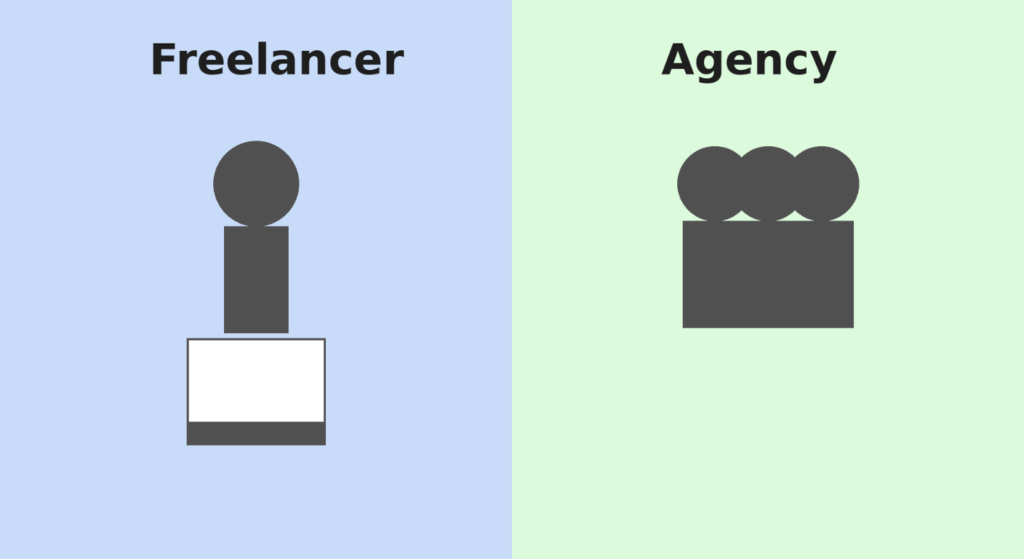
This is where most guides stop short. They’ll tell you agencies are great without explaining what you’re giving up with the alternatives.
| Option | Best For | Key Benefit | Limitation |
| In-house PPC manager | Brands with £10k+/month ad spend and time to hire | Full control, deep brand knowledge | High salary cost; skill gap risk if inexperienced |
| Freelancer | Small budgets under £2k/month; simple campaigns | Lower fees, direct contact | Often no team backup; may disappear post-setup |
| PPC management agency | Growth-stage businesses needing scale and accountability | Specialist team, tools included, ongoing optimisation | Higher minimum fees; requires clear brief to perform |
| DIY (Google Smart Campaigns) | Absolute beginners testing the water under £500/month | Zero management cost | Algorithm makes decisions you can’t audit or override |
Some experts argue freelancers offer the same quality as agencies at a fraction of the cost. That’s valid for straightforward single-campaign accounts with stable budgets. But if you’re running multi-product campaigns across Google and Microsoft Advertising, managing seasonal budget shifts, or trying to scale into new markets, a freelancer operating solo will hit a ceiling fast.
The Freelancer Problem Nobody Talks About
Users who’ve tried the freelancer route often report the same experience: strong onboarding, a well-structured initial build, then radio silence. The account runs. Nobody’s watching it.
This isn’t a dig at freelancers broadly plenty are excellent. The structural issue is accountability. An agency has account managers, internal reviews, and client reporting cycles that create built-in pressure to perform. A solo freelancer has none of that by design.
Or maybe I should say it this way: the setup is not the hard part. The ongoing work is.
What Does PPC Management Actually Cost?
Pricing structures vary and nobody seems to explain them clearly. Here are the three models you’ll encounter:
1. Percentage of ad spend
The agency charges 10–20% of your monthly ad budget. Common with larger agencies. Scales with you but incentivises higher spend, not necessarily better performance.
2. Flat monthly retainer
A fixed fee regardless of spend. Typical range: £500–£3,000/month for SMEs in the UK. Easier to budget. Better aligned with genuine optimisation effort.
3. Performance-based pricing
Agency charges against leads or revenue generated. Sounds ideal. Rarely offered because it requires full visibility into your CRM and attribution chain most businesses aren’t set up for it.
I’ve seen conflicting data on average agency fees; some sources cite £500/month as the SME entry point, others suggest £1,500 is more realistic for meaningful management. My read is this: below £750/month, you’re likely paying for reporting, not active optimisation. Know the difference before you sign.
What You Should Get for Your Fee
Whatever model you choose, a legitimate pay per click management service should include:
- Monthly (or bi-weekly) performance reporting with actual insights not just a data dump
- Access to your own Google Ads account at all times (never let an agency own the account)
- Clear KPIs agreed upfront: cost per lead, ROAS target, or conversion volume
- Documented negative keyword additions each month
- At minimum one ad copy test running per campaign
What most guides skip is the account ownership question. If an agency runs your ads inside their own Google MCC and you part ways, you may lose your historical data. Always insist the account is created under your Google login.
How to Choose a PPC Management Agency: The Questions That Actually Matter

Look, if you’re comparing two agencies and both have case studies and glowing testimonials, the differentiator isn’t their website. It’s what they say when you push them.
Ask these:
Can I see the account structure you’d build for a business like mine?
A good agency will sketch a campaign architecture in the first conversation. A bad one will talk vaguely about strategy until you sign.
How do you handle underperforming campaigns mid-month?
You want to hear: active bid adjustments, pause/test decisions, weekly checks. Not: we review at the end of the month.
What tools do you use for competitor analysis?
Platforms like SEMrush give agencies visibility into what competitors are bidding on and at what estimated CPC. If they’re not doing this, they’re flying partially blind.
Who specifically will manage my account?
At mid-size agencies, junior executives often run day-to-day. That’s not automatically a problem but you should know.
What’s your process when spend exceeds the budget cap?
Google Ads can overspend daily budgets by up to 2x. A managed service should have alerts in place. If they look surprised by the question, walk away.
One Counter-Intuitive Thing About Agency Size
Most people assume larger agencies mean better results. The data doesn’t really support that. What matters more is the seniority of whoever touches your account daily, and whether the agency’s existing client portfolio creates conflicts of interest (e.g., they manage three of your direct competitors).
A 5-person specialist PPC agency where a senior strategist actively manages your account will almost always outperform a 200-person digital agency where your account sits with a junior team.
Google Ads vs Microsoft Advertising: Do You Need Both?
This question comes up constantly, and the honest answer is: probably yes, eventually.
Google Ads captures the largest search volume. Microsoft Advertising (Bing Ads) typically delivers a 20–35% lower CPC for similar keywords, and its user base skews slightly older and more affluent which matters for certain B2B and higher-ticket consumer products.
A competent PPC management service will run both from a unified strategy, not treat them as separate silos. If an agency only offers Google Ads management, ask why.
To evaluate whether to add Microsoft Advertising to your mix, follow these steps:
- Export your top 10 converting keywords from Google Ads
- Run them through Microsoft Advertising’s keyword planner to compare search volume and CPC estimates
- If volume is at least 15% of Google’s, the channel is worth testing
- Set a 60-day pilot budget at 10–15% of your Google spend
- Compare cost per conversion at the 60-day mark before committing further
The Real Cost of Not Managing Your PPC Properly
Here’s the thing: the question isn’t whether you can afford PPC management. It’s whether you can afford not to have it.
An unmanaged account running £3,000/month in ad spend, with a 30% waste rate on irrelevant search terms (a conservative estimate for accounts without negative keyword lists), is burning £900/month on clicks that will never convert. That’s £10,800 per year in pure waste. A management fee of £800/month starts looking very different in that context.
This is the calculation most business owners do last, not first.
FAQs
Q: What’s the best way to find a reliable PPC management agency?
A: Ask for a trial audit of your existing account before committing. Any credible agency will identify specific structural issues, not just promise better results. Check that they’ll give you full account ownership from day one.
Q: How do I know if my PPC campaigns are being actively managed?
A: Request a change log. Google Ads records every edit made to your account, timestamped. If the log shows minimal activity between reporting calls, the account is being monitored, not managed.
Q: Should I outsource PPC management or hire in-house?
A: If your monthly ad spend is under £8,000, outsourcing to a specialist agency is almost always more cost-effective than a full-time hire. Above that threshold, a blended model agency plus in-house PPC lead often produces the best results.
Q: Why does my cost per click keep rising even when I don’t change anything?
A: Auction competition increases over time as more advertisers enter your keyword space. Without active bid management and Quality Score improvement, your CPC rises while your ad position falls. This is precisely what ongoing PPC management addresses.
Q: When should I consider switching PPC agencies?
A: If you haven’t seen a structured performance review in 60 days, if your account change log is sparse, or if your agency cannot explain why a specific metric moved those are clear signals. Don’t wait for a contract anniversary to act.
This guide covers pay per click management for businesses running search campaigns on Google Ads and Microsoft Advertising. It does not cover social PPC (Meta, LinkedIn Ads), shopping campaign management, or programmatic display each of which operates under different management frameworks.