If you’ve been running paid traffic in any gray-area vertical supplements, lead gen, crypto, finance, anything adjacent to regulated industries you’ve almost certainly come across cloaking. Maybe in a forum thread. Maybe because your own ads keep getting disapproved and someone told you it was the only way through. Maybe because you suspect a competitor is doing it and somehow staying live.
This article explains exactly what’s happening under the hood: how cloaking works technically, how Google actually detects it (not just the policy language, the real mechanism), and what enforcement looks like when they catch it. Not the watered-down version you get from a support page. The version that actually helps you make an informed decision.
What Ads Cloaking on Google Actually Is
Ads cloaking on Google refers to the practice of showing Google’s ad review system a different landing page than the one real users see after clicking an ad. The goal is to pass policy review with compliant content, then redirect actual visitors to a page that would otherwise be disapproved.
That’s the core of it. One URL, two completely different experiences one for the crawler, one for the human.
The technique exploits a fundamental tension in how automated ad review systems work. Google’s bots crawl the destination URL attached to your ad. If that URL returns a clean, policy-compliant page when it detects a crawler’s user-agent or IP range, the ad passes review. Real users identified by different signals get sent somewhere else. Something the ad would never have been approved to run.
Cloaking isn’t new. It migrated from black-hat SEO into paid advertising as policy enforcement got tighter in high-competition niches. The mechanics are old. What’s changed is how Google detects it.
How Cloaking Actually Works in Google Ads (The Technical Version)
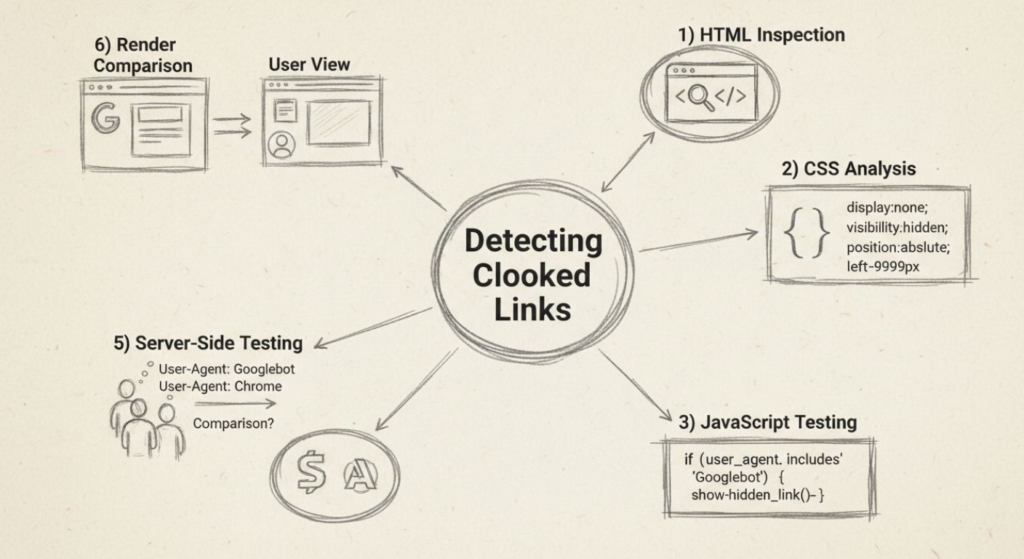
Most explanations stop when you show one page to bots and another to users. That’s accurate but incomplete. Here’s what’s actually happening in practice, and why it matters for understanding why cloaking eventually fails even when it works at first.
The three most common implementation methods:
1. User-agent detection
The cloaking script reads the HTTP user-agent header from incoming requests. If it matches a known crawler string Googlebot, AdsBot-Google, or similar it serves the clean page. Every other user-agent triggers the redirect to the real offer page. This is the oldest method and, frankly, the most detectable.
2. IP-range filtering
Google publishes its crawler IP ranges. Cloaking setups maintain lists of these ranges and block or redirect anyone coming from them. Tools like Keitaro, a traffic distribution platform widely used in affiliate marketing, can be configured to filter traffic this way, routing by IP, device, geo, or referrer. Keitaro isn’t a cloaking tool by design, but it’s frequently misconfigured to function as one. Same applies to Voluum and similar tracking stacks.
3. JavaScript-based rendering detection
More sophisticated setups check whether JavaScript executes correctly in the visiting browser. Headless crawlers sometimes behave differently from real browsers when rendering JS. The cloaking layer detects this and serves compliant content accordingly.
Here’s the thing: each of these methods has a detectable fingerprint. And Google isn’t just sending the same crawler every time.
The dual-layer problem most cloakers don’t account for:
Google’s review process has two distinct phases that operate on different schedules and use different infrastructure. Phase one is automated AdsBot-Google crawls your destination URL when the ad is submitted, and at intervals afterward. Phase two is human review, triggered either by automated flags, user complaints, or algorithmic signals that something changed post-approval.
What most guides miss is that the human review team doesn’t always use Google’s known IP ranges. They use residential proxies, VPNs, manual browsing from non-Google network addresses, and device profiles that are specifically designed to look like regular users. Your IP filter won’t catch them. Your user-agent block won’t catch them. By the time a human reviewer reaches your real landing page, your cloaking setup has already passed them through.
This is why cloaking works for a window sometimes days, sometimes weeks and then collapses. Not because Google got smarter at that moment. Because the second layer of review was always coming.
Google’s Official Policy on Cloaking and What It Actually Covers
Google’s ad policy prohibits cloaking explicitly under its circumvention policies. The language is broad by design: any technique that shows different content to users than to Google is covered, regardless of the technical method used.
According to Google’s 2023 Ads Safety Report, Google removed over 5.5 billion ads and suspended more than 12.7 million advertiser accounts for policy violations in 2023, with cloaking explicitly named as one of the circumvention techniques driving account-level enforcement. That’s not a small compliance operation. That’s a scaled enforcement machine.
Or maybe I should say it this way the policy isn’t the real enforcement mechanism. The detection system is. The policy just defines what happens after detection.
What the policy specifically flags:
- Destination URLs that behave differently based on visitor characteristics
- Redirect chains that pass review but change behavior post-click
- Landing pages that are modified after ad approval to serve different content
- Any use of technical means to misrepresent the final destination to Google’s systems
Quick note: The policy applies to both the advertiser running the cloaked ad AND, in some interpretations, agencies or individuals who set up the cloaking infrastructure on behalf of an advertiser. Account-level liability doesn’t stay with the technical implementer it attaches to whoever owns the account.
How Google Detects Ads Cloaking (What They Don’t Tell You Publicly)
This is the section that actually matters for anyone trying to understand why enforcement happens when it does, not just that it happens.
To detect cloaking in Google Ads, Google uses a layered approach:
- AdsBot crawls destination URLs at submission and at randomized post-approval intervals
- Automated systems compare crawl results against user-reported landing page behavior
- Human reviewers access pages using non-Google IPs and residential proxy networks
- Machine learning models flag statistical anomalies in Quality Score vs. user engagement data
- Advertiser complaint systems surface suspicious ads for manual review queues
Each step builds on the previous one. A cloaking setup that defeats step one will still encounter steps three and four.
The signal most marketers don’t think about: Quality Score divergence.
If your crawled landing page is squeaky clean and highly relevant to your ad copy, your Quality Score should be high. But if real users are landing on something completely different, a page with different content, slower load times, higher bounce rates, or conversion flows that don’t match the declared product engagement signals diverge from what the Quality Score would predict.
That divergence is a flag. It doesn’t prove cloaking on its own, but it’s what moves an account from automated monitoring to human review queues faster than almost anything else.
Most people assume Google catches cloaking by identifying the cloaking script itself. The data says otherwise. Detection often starts with behavioral signal discrepancy, not technical fingerprinting.
I’ve seen conflicting data on this; some sources inside affiliate communities claim Google’s bot detection has become too sophisticated for IP filtering to work at all, while others claim properly maintained IP lists still buy a meaningful runway. My read is that both are partially true: IP filtering delays detection but doesn’t prevent it, and the window is getting shorter as Google’s residential proxy infrastructure expands.
Quick Comparison: Cloaking vs. Compliant Redirect Techniques
Cloaking vs. compliant redirect flows:
Cloaking is used when the final destination page violates Google Ads policy; the intent is deception. Compliant redirect flows (like tracking pixel pass-throughs or bridge pages) show Google the same content real users see. The key difference is whether the destination experience matches what Google’s crawler observed.
| Option | Best For | Key Benefit | Limitation |
| Cloaking | Bypassing policy review | Short-term ad approval in restricted niches | Account suspension, MCC-level bans, potential legal exposure |
| Bridge/pre-lander page | Compliant traffic warming | Passes review legitimately | Requires offer page to also be compliant |
| Direct compliant landing page | Long-term account health | Lowest enforcement risk | Limits offers available to promote |
| Traffic distribution (Keitaro/Voluum) | Legitimate geo/device routing | Powerful segmentation without policy risk | Can be misconfigured into cloaking behavior unintentionally |
| Policy-compliant advertorial | Gray-area niches (supplements, finance) | Mimics editorial content legally | Requires careful FTC/Google dual compliance |
What Actually Happens When Google Catches You
This is where most explainer articles go vague. Your account may be suspended. That’s technically true. It’s also not the full picture.
Enforcement levels, in order of severity:
Ad disapproval: The lightest touch. Individual ads are disapproved, often with a generic destination not working or circumvention violation code. You can appeal. Most appeals fail if the underlying setup hasn’t changed, because the review team sees the same signals.
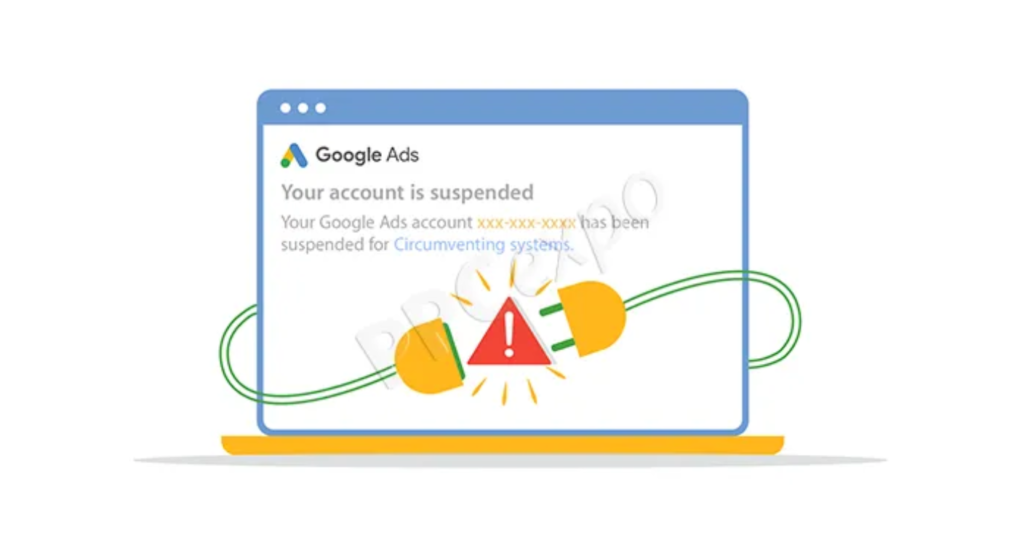
Account suspension: The standard outcome for confirmed cloaking. Your Google Ads account is suspended, all active campaigns stop immediately, and billing continues for any charges already incurred. You receive a notification citing the circumvention policy.
MCC-level suspension: This is what most guides don’t mention. If you operate under a My Client Center (MCC) common for agencies and sophisticated affiliates managing multiple accounts a confirmed cloaking violation in one account can trigger review of all accounts under the same MCC. Google links accounts by payment method, business verification details, phone number, IP history, and device fingerprints. Creating a new account after suspension, without resolving the underlying issue, typically results in the new account being suspended within days.
Funds forfeiture: Google can withhold advertising credits and, in some cases, retain prepaid balances as part of enforcement action for policy violations.
Legal exposure: This is the part almost no affiliate marketing forum thread ever mentions. Depending on implementation method and jurisdiction, cloaking that involves deceptive redirection may implicate the Computer Fraud and Abuse Act (CFAA) in the United States, which prohibits unauthorized access to computer systems. Google’s terms of service constitute a legal agreement. Systematic cloaking that circumvents Google’s systems isn’t just a policy issue it’s a potential civil liability. Google has pursued legal action against advertisers for circumvention violations before. It’s rare, but it’s not hypothetical.
Some experts argue that legal risk is overstated for individual affiliates running small-volume cloaking setups. That’s valid for someone running one account with modest spend. But if you’re managing campaigns at scale, across multiple accounts, with shared infrastructure, the risk profile changes significantly.
Compliant Alternatives That Actually Work in Gray-Area Niches
Look, if you’re running offers in a niche where cloaking seems like the only way through, there are compliant paths that get ads approved without the account-destruction risk. They require more work. They also still exist 12 months from now.
What actually works:
Bridge pages built for compliance: A pre-lander that educates, discloses, and warms traffic before the offer page. The key is that the bridge page itself must be compliant, and the offer page it links to must also be policy-acceptable. The bridge page can’t be a fig leaf for a violating final destination.
Advertorial-style landing pages: Used heavily in supplements and finance. These present information in an editorial format, include required disclosures, and link to product pages that also carry compliant claims. FTC compliance and Google Ads compliance overlap here satisfying one often helps with the other.
Legitimate traffic segmentation via tracking platforms: Keitaro and Voluum are powerful tools when used correctly. Routing by geography, device type, or traffic source isn’t cloaking its segmentation. The rule is that every segment must see content that Google’s crawler would also approve. The violation happens when one segment (Google’s bots) sees something different from another (real users), not when segmentation itself occurs.
Account structure and offer selection: Sometimes the real answer is that the offer itself isn’t approvable, and no amount of landing page work will change that. Working backward from compliant offers rather than forward from prohibited ones is genuinely the more durable strategy for anyone building a long-term paid traffic business.
FAQs
Q: What’s the best way to know if my ad was approved for cloaking?
A: Check your disapproval in Google Ads look for circumvention or destination mismatch codes. A cloaking flag usually triggers account-level review, not just individual ad disapproval.
Q: How does Google detect cloaking if I’m using a private IP filter?
A: Google uses residential proxy networks and non-Google IPs for human review. IP filtering stops automated crawlers but doesn’t stop manual reviewers browsing from standard ISP addresses.
Q: Should I appeal a Google Ads suspension if cloaking was involved?
A: Only appeal after fully removing the cloaking setup and replacing it with a compliant landing page. Appealing with the same technical setup in place almost always results in a rejected appeal and faster permanent action.
Q: Why does cloaking work at first but then get caught?
A: Automated review passes the ad initially. Human review using non-Google IPs follows later. The gap between approval and human review is the window most cloaking exploits. That window is getting shorter.
Q: When should I use traffic distribution tools like Keitaro without triggering a violation?
A: Use them for legitimate segmentation geo, device, traffic source as long as every segment receives content Google’s crawler would also approve. The violation isn’t segmentation itself; it’s showing Google something different from what users see.
This guide covers Google Ads cloaking from a policy and detection standpoint. It does not constitute legal advice. If you’re facing active enforcement action or legal exposure related to ad policy violations, consult a qualified attorney familiar with digital advertising law.