If you’ve ever set up a Google Ads campaign yourself, watched the budget drain in three days, and wondered where the money actually went you’re not alone. That experience is almost universal among business owners who try PPC without a background in it.
Here’s the thing: the platform isn’t broken. The setup probably was.
This article breaks down what a legitimate Google Ads service actually includes, what agencies charge, how to tell if your current provider is doing the job right, and because it genuinely matters how to separate real Google Ads management from the adware pop-ups that show up under a suspiciously similar name.
First, Let’s Clear Up the Confusion: Real Google Ads Service vs. the Pop-Up Problem
Search google ad services and you’ll find two completely different conversations happening at once. One is about hiring a professional to run your paid search campaigns. The other is about a browser pop-up that users report seeing after a suspicious software install often tied to adware that mimics Google’s branding.
They are not the same thing.
If you’re seeing repeated pop-ups or permission requests from something calling itself Google Ad Services in your browser, that is not Google’s advertising platform. Google’s legitimate ad delivery system runs silently in the background of websites you visit it doesn’t generate browser alerts or ask for permissions. That pop-up is almost certainly adware, and the fix is a malware scan, not an ad account.
Quick note: Users on Chrome support forums have flagged this confusion since at least 2019, and it still trips people up. If that’s what brought you here run Malwarebytes, check your browser extensions, and you’ll likely resolve it fast.
What the rest of this article covers is the other Google Ads service: the professional management of paid campaigns on Google’s advertising platform to drive traffic, leads, and sales for your business.
What Is a Google Ads Service, Exactly?
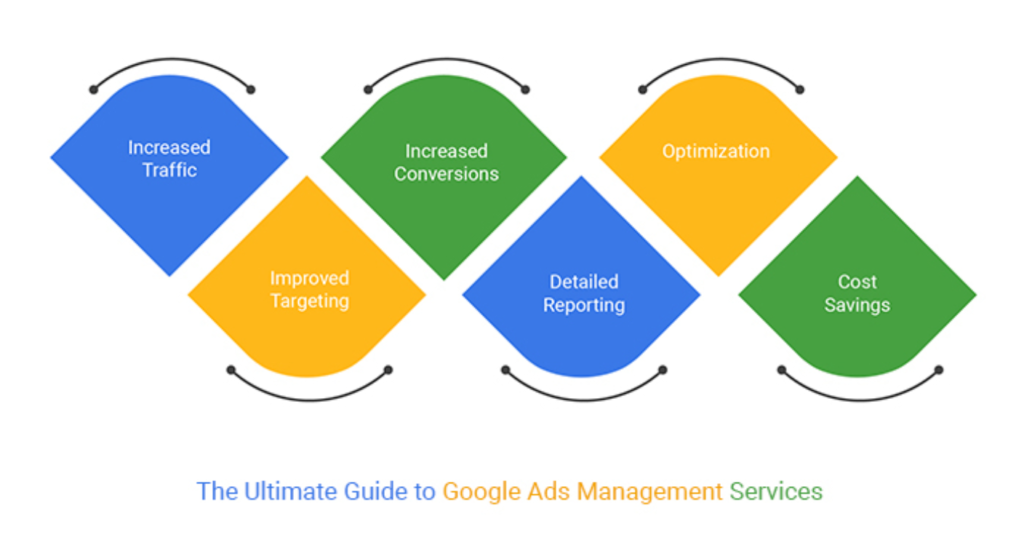
Google Ads service refers to the professional management of paid advertising campaigns on Google’s platform including campaign strategy, keyword research, ad copywriting, bid optimization, and performance reporting delivered by an agency or specialist on behalf of a business.
One clarifying note: the platform itself is free to access. You pay Google directly for ad clicks. The service is what you pay a provider to manage that spend effectively.
According to Google’s own Economic Impact Report (2023), businesses earn an average of $2 in revenue for every $1 spent on Google Ads but that figure assumes competent campaign management. Poorly structured campaigns, which are the norm in DIY setups, routinely invert that ratio.
The gap between a well-managed account and a self-managed one comes down to a handful of specifics most tutorials skip:
- Negative keyword lists: filtering out irrelevant searches before they cost you money
- Match type strategy: the difference between broad, phrase, and exact match is not cosmetic; it determines who sees your ads
- Quality Score optimization: a lower Quality Score means you pay more per click than a competitor bidding the same amount
- Conversion tracking setup: if this isn’t configured correctly from day one, you’re flying blind on ROI
- Bid strategy selection: Google’s automated strategies like Target CPA and Maximize Conversions work well under the right conditions and catastrophically under the wrong ones
Or maybe I should say it this way: the platform gives you the tools, but it doesn’t tell you when you’re using them wrong. That’s what a service provider is supposed to catch.
What Does a Google Ads Management Service Actually Include?
This is where providers differ significantly, and where you need to read contracts carefully.
A credible Google Ads management service should include at minimum:
Account setup and structure
Campaign architecture matters more than most business owners realize. A well-structured account separates campaigns by goal, ad groups by tightly themed keyword clusters, and landing pages by offer. Tools like SEMrush are commonly used at this stage to conduct competitor keyword analysis identifying which terms rivals are bidding on, what their ad copy looks like, and where gaps exist.
Ongoing bid and budget management
This isn’t set-and-forget. Bids shift based on auction competition, seasonality, device performance, and time-of-day data. A managed service reviews and adjusts these on a weekly cadence at minimum.
Ad copy creation and A/B testing
Google’s Responsive Search Ads allow up to 15 headlines and 4 descriptions — the algorithm tests combinations. But someone has to write those assets intelligently, and the testing has to be monitored. Agencies using platforms like WordStream can audit ad copy performance across an account and flag underperforming variants fast.
Conversion tracking and reporting
Monthly reporting should show you cost per conversion, conversion rate by campaign, impression share, and ROAS (return on ad spend) not just clicks and impressions. If a report doesn’t show you what your money produced, it’s a vanity report.
What most providers don’t include by default: landing page optimization, SEO integration, or creative design. Confirm scope before signing.
How Google Ads Service Pricing Actually Works
Pricing is one area where the industry is genuinely inconsistent. Here’s an honest breakdown.
Flat Monthly Fee
A fixed monthly retainer regardless of ad spend. Common range: $500–$2,000/month for small business accounts. Predictable for budgeting. Can create a misalignment of incentives the agency has no financial reason to push your spend higher, which is either a pro or a con depending on your perspective.
Percentage of Ad Spend
Typically 10–20% of monthly ad spend. More common among larger agencies. Align the agency’s revenue with your investment but watch for providers who inflate spend to inflate their fee. A $5,000/month spend at 15% = $750/month in management fees. That math compounds fast.
Performance-Based (Rare, Scrutinize Carefully)
Some providers charge based on leads generated or revenue driven. Sounds appealing. In practice, attribution disputes are common, and the definition of lead gets murky. This model works in specific verticals e-commerce with tight tracking and is risky in lead-gen businesses where deal quality varies.
Quick Comparison
| Model | Best For | Key Benefit | Limitation |
| Flat Monthly Fee | Small businesses, fixed budgets | Predictable cost | No incentive to scale spend efficiently |
| Percentage of Spend | Growing accounts, $3K+ monthly spend | Agency growth tied to your growth | Fee scales with spend, not results |
| Performance-Based | E-commerce with clean attribution | Pay for outcomes | Attribution disputes, narrow applicability |
| Hybrid (Fee + %) | Mid-market businesses | Balances predictability and alignment | More complex contracts |
I’ve seen conflicting data on average agency fees; some industry surveys suggest the median is closer to 12% of spend, while others peg flat-fee minimums at $750/month. My read is that the right number depends almost entirely on your monthly budget and what’s actually included. Ask for a scope-of-work document before comparing prices.
How to Evaluate a Google Ads Service Provider Before You Sign
Most businesses pick an agency the wrong way. They compare prices, look at a few testimonials, and go with whoever sounds most confident on a discovery call. That’s not evaluation, that’s vibes.
Here’s what to actually check:
1. Ask to see a real account audit
A competent provider should be able to look at your existing Google Ads account and identify specific structural problems within 20–30 minutes. Vague feedback like your campaigns need optimization is a red flag. Specific feedback like your broad match keywords are triggering irrelevant search terms and you have no negative keyword list is what expertise sounds like.
To audit a provider’s credibility, follow these steps:
- Grant them view-only access to your Google Ads account before signing anything.
- Ask for a written audit identifying at least 3 specific campaign issues.
- Verify their Google Partner or Premier Partner status at ads.google.com/intl/en_us/home/partners/.
- Request one reference from a client in a similar industry.
- Confirm conversion tracking is part of their onboarding not an add-on.
2. Verify Google Partner status
Google’s Partner and Premier Partner badges aren’t perfect signals, but they confirm the agency meets minimum spend thresholds and has certified staff. Check it yourself at Google’s official partner directory don’t take a badge on their website at face value.
3. Understand the reporting cadence
Monthly reporting is standard. Bi-weekly is better for active accounts. Real-time dashboard access (via Google Looker Studio or similar) means you can check performance without waiting for a PDF.
4. Clarify who owns the account
This is the one most business owners miss. Your Google Ads account should be owned by your business email, with the agency added as a manager. If the agency owns the account, you lose all historical data if you part ways. Non-negotiable.
Some experts argue that newer agencies without years of case studies can still outperform established ones because they’re hungrier and more current on platform changes. That’s valid for some scenarios. But if you’re spending $3,000+ per month in ad budget, you want someone who has managed accounts at that scale not someone learning on your dollar.
Signs Your Current Google Ads Service Is Underperforming
Look, if you’re already working with a provider and something feels off, here’s what actually matters.
Warning signs that should prompt an immediate conversation:
- Reports show only impressions and clicks no conversion data
- You don’t have access to your own account
- The same ad copy has been running for 4+ months with no tests noted
- Your Quality Scores are below 5 on core keywords (check this yourself in the Keywords tab)
- No mention of search term reports these show what actual searches triggered your ads
- Monthly call consists entirely of things are trending in the right direction
What most guides skip is the search term report check. Pull it yourself. If you see wildly irrelevant searches eating budget free anything, competitor brand names you don’t want to target, or searches in a geography you don’t serve, that’s a structural problem your provider should have caught.
Counter-intuitive insight: A higher click-through rate (CTR) is not automatically a sign of good campaign management. CTR measures appeal to searchers. Conversion rate measures whether those searchers actually become customers. Agencies that optimize for CTR without tracking conversions can make an account look great while delivering nothing.
Google Ads Service for Small Businesses: Is It Worth the Cost?
The honest answer is: it depends on your margins and your monthly budget.
At under $500/month in ad spend, the management fee will often exceed the value you can extract from a professionally managed account. Most reputable agencies have a minimum ad spend requirement of $1,000–$1,500/month for this reason. Below that threshold, self-managing with a solid course or audit is more cost-effective.
Above $2,000/month in ad spend, professional management almost always pays for itself provided the provider is actually doing the work. The variables that compound at higher spend levels (auction dynamics, bid adjustments, audience layering, negative keyword depth) become genuinely complex and genuinely expensive to get wrong.
According to WordStream’s analysis of Google Ads benchmarks across industries, the average conversion rate on Google Search Ads is 4.40% but top-quartile accounts convert at 11.45%. That gap is almost entirely explained by account management quality, not industry or budget size.
Google Ads works for small businesses in local services (plumbing, legal, dental, home services), e-commerce with clear margins, and B2B lead generation. It works less reliably for businesses with very long sales cycles, commodity products with paper-thin margins, or markets where search volume for relevant terms is genuinely low.
This works best for businesses with a clear customer lifetime value and a defined conversion goal. It won’t help if you can’t articulate what a lead or sale is worth to you because without that number, you can’t assess whether any campaign is profitable.
FAQs
Q: What’s the best way to find a reliable Google Ads service provider?
A: Check for Google Partner certification, ask for a written account audit before signing, verify you’ll own the account, and request a reference from a client in your industry. Avoid providers who report only clicks and impressions.
Q: How do I know if my Google Ads are actually working?
A: Conversion tracking must be set up correctly first. Then measure cost per conversion and ROAS not CTR or impressions. If your provider can’t show you cost-per-lead data, the account isn’t being managed to a standard.
Q: Should I manage Google Ads myself or hire an agency?
A: Below $1,500/month in ad spend, self-management with a structured course can make sense. Above that, professional management typically pays for itself the complexity of bid strategy, negative keywords, and Quality Score optimization scales faster than most DIY learners can track.
Q: Why does Google Ad Services keep appearing as a browser pop-up?
A: That pop-up is not Google’s advertising platform, it’s adware mimicking Google’s branding. Run a malware scan (Malwarebytes works), remove suspicious browser extensions, and reset your Chrome permissions. It’s unrelated to Google Ads, the advertising service.
Q: When should I switch Google Ads agencies?
A: Switch when you lose account access, when reporting shows no conversion data after 60+ days, when the same campaigns run unchanged for more than a quarter, or when you can’t get a straight answer about what your budget actually produced.
This article covers managed Google Ads services for search and display campaigns. It does not address Google Shopping campaigns, YouTube Ads management, or Performance Max-specific strategies that warrant separate treatment given their distinct setup requirements.