
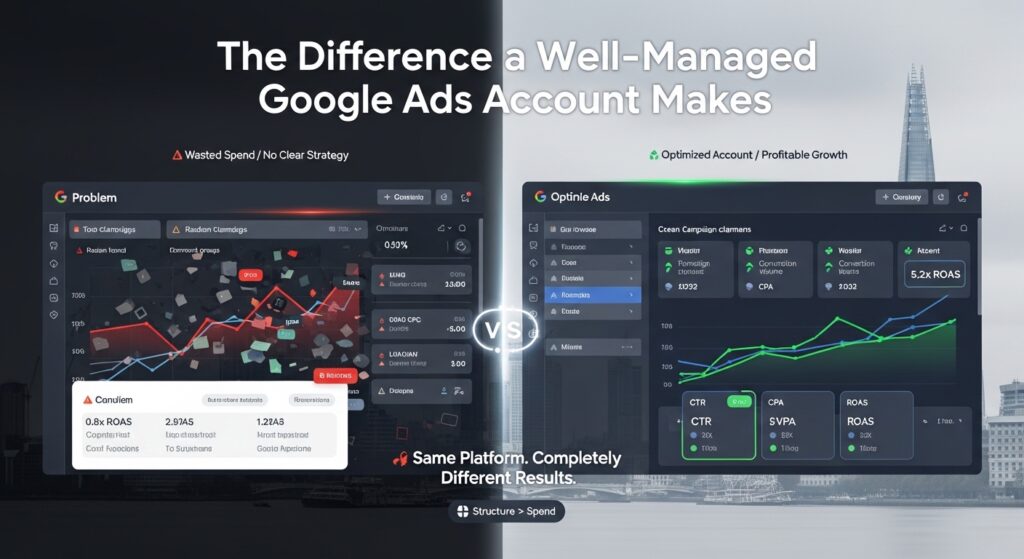
This guide is written for London-based business owners and marketing managers spending at least £1,000/month on Google Ads who are evaluating whether to hire a PPC specialist or agency. It does NOT cover enterprise-level programmatic advertising or paid social-only strategies.
Burning money on Google Ads is surprisingly easy. Getting it back requires someone who actually knows what they’re doing.
If you’ve landed here, you’ve probably already tried the DIY route or handed your campaigns to someone who promised results and delivered reports full of vanity metrics. Either way, you’re not where you want to be.
Here’s what this guide does: it gives you a no-fluff framework to evaluate, hire, and hold accountable a PPC expert in London including what to pay, what to demand before signing anything, and the two questions most people never think to ask.
What a PPC Expert in London Actually Does
A PPC expert in London is a paid search specialist either freelance or agency-side who manages pay-per-click advertising campaigns, primarily on Google Ads, with the goal of generating measurable return on ad spend (ROAS) for their clients. A credible specialist handles campaign architecture, keyword strategy, audience targeting, bid management, ad copy testing, and conversion tracking not just budget allocation.
That last part matters. A surprising number of people calling themselves PPC managers are essentially doing one thing: adjusting bids and writing the occasional ad. Real PPC management is substantially more involved.
According to WordStream’s Google Ads Industry Benchmarks (2023), the average click-through rate across all industries on Google Search sits at 6.11% but businesses without dedicated PPC management routinely see wasted spend rates above 76% of their total budget, driven by poor keyword targeting and match type misuse. That’s not a minor inefficiency. That’s most of your budget disappearing before it ever reaches a qualified buyer.
The London market adds its own layer. Competition for terms like solicitor London or accountant London is genuinely fierce, CPCs are higher than UK averages, and the audience sophistication varies wildly by sector. A PPC generalist who manages campaigns in Leeds or Bristol isn’t automatically equipped for a London e-commerce brand competing against well-funded rivals bidding on the same inventory.
Quick note: PPC experts and Google Ads consultants are often used interchangeably but some specialists focus exclusively on paid search, while others manage Meta Ads, LinkedIn, or Microsoft Advertising alongside Google. Clarify scope before the first call.
The Real Vetting Questions What to Ask Before You Sign Anything
Most businesses hiring a PPC specialist ask the wrong questions. They focus on years of experience and certifications. Those matter but they’re the floor, not the ceiling.
What you should actually demand:
1. A pre-engagement audit of your existing account
Any credible PPC expert in London should offer (or charge a modest fee for) an audit of your current Google Ads account before proposing a management structure. This audit should identify: wasted spend by campaign, keyword match type issues, Quality Score problems, and conversion tracking gaps. If a prospective specialist can’t produce a written audit finding within two business days of access, that tells you something.
2. Specific case study data not testimonials
Ask for campaign examples with before/after ROAS, CPA, or conversion rate data from clients in a similar sector or spend range. Testimonials saying great to work with are useless here. You want numbers. A good specialist will have them.
3. Their approach to negative keywords
This sounds technical. It’s actually a simple litmus test. Ask how they manage negative keyword lists and how often they review search term reports. A vague answer we optimise regularly is a red flag. A strong answer references specific cadence, match type logic, and tiered negative lists at campaign and ad group level.
Look, if you’re spending £5,000/month on Google Ads and haven’t had someone review your search term report in the last 30 days, you are almost certainly funding irrelevant clicks right now.
4. Proof of active Google Ads certification and what it actually proves
Google Partner or Premier Partner status indicates the agency meets minimum spend thresholds and maintains certified staff. What is Google Partner Status and Does It Matter. It’s a baseline credibility signal, not a guarantee of performance. Individual specialists should hold current Google Ads certifications (verifiable via Google’s Skillshop). Worth checking — certifications expire annually.
5. Reporting structure and frequency
Before any contract, agree on what a report looks like. Vanity metrics (impressions, clicks) without conversion data and ROAS context are a red flag. A serious PPC manager will report on cost per conversion, impression share, Quality Score trends, and budget pacing at minimum, monthly.
What PPC Management Actually Costs in London in 2025
This is where most guides go quiet. Let’s be direct.
There are two primary pricing models in the London PPC market:
Quick Comparison
| Model | Best For | Key Benefit | Limitation |
| Percentage of Ad Spend (typically 10–20%) | Businesses spending £5,000+/month on ads | Scales with ambition; specialist is incentivised to grow spend | Creates misaligned incentives — more spend = more fees, regardless of ROAS |
| Flat Monthly Retainer (typically £800–£3,500/month in London) | SMEs with stable budgets under £10,000/month | Predictable cost; specialist focused on efficiency, not spend volume | Less flexibility if ad spend fluctuates significantly |
| Hourly Consulting (typically £75–£200/hour in London) | Audits, one-off strategy sessions, account reviews | Pay only for what you need | Not suited to ongoing campaign management |
| Project-Based (fixed fee for setup + handover) | Businesses who want a built-and-trained account | Good for in-house teams who’ll self-manage post-setup | Requires internal capability to sustain after handover |
The percentage-of-spend model is common. It’s not always wrong. But understand the incentive structure: if your specialist earns more when you spend more, their advice on whether to increase budget isn’t entirely neutral. Flat retainers remove that dynamic.
Or maybe I should say it this way: the model itself isn’t the problem the transparency around it is. Ask any prospective specialist to explain how they’re compensated and whether they earn referral fees from any ad platforms. A straight answer is a good sign.
Realistic budget expectations for London in 2026:
- Freelance PPC specialist: £800–£1,800/month retainer for full management of one Google Ads account
- Boutique PPC agency: £1,500–£3,500/month depending on scope, ad spend, and number of platforms
- Large full-service agency with PPC department: £3,000–£8,000+/month — though PPC is often one of several services, not always the priority
There’s a view held by some marketing consultants that freelancers are always cheaper and therefore riskier. Freelance vs Agency for Google Ads Management, That’s not borne out in practice. I’ve seen conflicting data on this some industry surveys suggest freelance PPC managers outperform agency counterparts on lean budgets, others show agencies win on accounts with complex multi-platform setups. My read is this: for budgets under £8,000/month on a single platform, an experienced freelance PPC specialist is often the better fit.
Freelance PPC Manager vs London Agency Which Is Actually Right for You?
Some experts argue that agencies always offer more stability, account continuity, backup resources, and broader tooling. That’s valid for enterprise clients managing £50,000+ monthly ad spend across six platforms. But if you’re an SME spending £3,000–£10,000/month on Google Ads, that argument doesn’t hold the same weight.
Freelance PPC specialist:
You typically deal with one person who owns the account fully. They’re accountable. When something goes wrong and things always go wrong in PPC there’s no internal blame loop. They fix it. The risk is capacity: if they take on too many clients or face personal disruption, your account can suffer.
Boutique PPC agency:
More structured reporting. Usually a dedicated account manager plus a strategist. More likely to have experience across multiple sectors. The risk is dilution: your account may be managed day-to-day by a junior executive while the senior who sold you the contract focuses elsewhere.
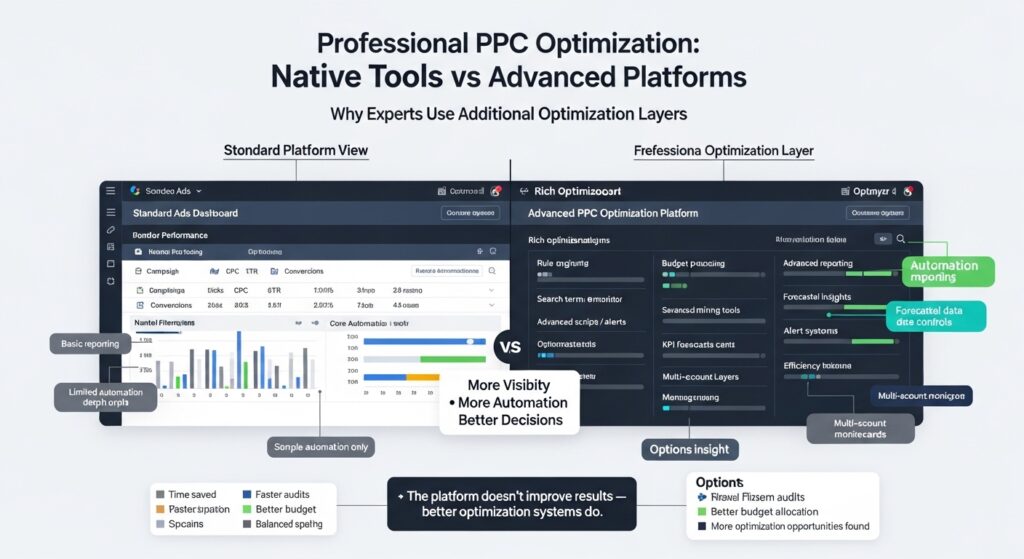
The honest answer: Either can work. What matters more than the model is the individual’s track record, their process transparency, and whether they use professional-grade tooling.
On that point credible London PPC specialists typically use tools like SEMrush for competitor ad intelligence and keyword gap analysis, and Optmyzr for automated bid management, performance monitoring, and structured reporting. If a specialist you’re evaluating uses only the native Google Ads interface with no third-party optimisation layer, ask why.
Audit Process
A pre-engagement audit is the single most revealing step in the hiring process. It shows you how a specialist thinks before they have anything to gain from flattering you.
To get a meaningful PPC audit, follow these steps:
- Grant read-only access to your Google Ads account not full admin access at this stage
- Request a written audit document, not a verbal walkthrough or slide deck summary
- Ask them to identify your top three sources of wasted spend with specific evidence
- Request their recommended account restructure or priority action list
- Review whether their findings align with your gut instinct about where campaigns underperform
Each step reveals something. Google Ads Skillshop certification verification, A specialist who jumps straight to a restructure proposal without identifying waste first is selling, not auditing.
What Most Guides Skip Entirely Red Flags That Aren’t Obvious
The obvious red flags you already know: no case studies, guaranteed results promises, locked-in contracts with no exit clause.
Here are the less obvious ones.
They can’t explain their Quality Score strategy. Quality Score affects your cost-per-click directly. A QS of 3 vs. 8 on the same keyword can mean paying twice as much for the same position. If a specialist hand-waves this topic, it’s a gap.
They pitch broad matches as a starting strategy. Broad match keywords have their place. Starting a new campaign in a competitive London market on broad match without a tightly managed negative keyword list is how budgets evaporate in the first week. A specialist who recommends this without immediately explaining the safeguards isn’t ready for your account.
No mention of conversion tracking setup. You cannot optimise a campaign you can’t measure. If a specialist doesn’t open the conversation with conversion tracking Google Tag Manager setup, goal verification, GA4 integration before touching bids or budgets, something’s wrong.
What most guides skip is this: the quality of a PPC specialist’s conversion tracking setup is often a more reliable indicator of their competence than their certifications. Anyone can pass a Google Ads exam. Building accurate, attribution-correct conversion tracking takes real technical skill.
FAQs
Q: What’s the best way to find a trusted PPC expert in London?
A: Ask for a pre-engagement audit of your existing Google Ads account. Any credible specialist will surface specific waste and restructure priorities not just pitch their services. Use that audit as your real interview.
Q: How do I know if my PPC manager is actually doing a good job?
A: Track cost per conversion and ROAS monthly, not just clicks or impressions. If those numbers aren’t improving after 90 days with a clear strategy in place, you need a frank conversation about why.
Q: Should I hire a freelance PPC specialist or a London agency?
A: For monthly ad spend under £10,000 on a single platform, an experienced freelance PPC manager often delivers more focused accountability than a mid-size agency where your account is managed by a junior. Above that threshold, agency infrastructure becomes more valuable.
Q: Why does PPC management cost so much when I can run ads myself?
A: You can run ads yourself. The question is whether they’re profitable. According to WordStream (2023), unmanaged accounts waste over 76% of budget on irrelevant traffic. Specialist management fees are typically recovered within the first month through waste reduction alone.
Q: When should I switch PPC specialists if results aren’t improving?
A: Give any new specialist 60–90 days before judging performance — campaign learning periods are real. But if you have no written strategy, no conversion tracking in place, and no clear reporting after 30 days, don’t wait for 90.
Conclusion
Before you sign any agreement with a PPC expert or agency in London, confirm the following:
- Written audit of your current account provided (not just a verbal overview)
- At least two sector-relevant case studies with performance data shared
- Pricing model explained clearly percentage of spend, flat fee, or hybrid
- Conversion tracking audit included in onboarding scope
- Reporting cadence and format agreed in writing
- Contract includes a 30-day exit clause (standard for reputable specialists)
- Google Ads certification verified via Skillshop (for individuals) or Google Partner status confirmed (for agencies)
- Named account manager identified not just “the team”
This is not a long checklist. Any reputable PPC expert in London should clear all of these without hesitation. If they push back on any item, ask why.
This guide covers the process of evaluating and hiring a PPC expert or agency in London for Google Ads management. It does not address paid social advertising (Meta, TikTok, LinkedIn), programmatic display, or enterprise-level multi-channel media buying.