
If you’ve asked an agency what Google Ads costs and walked away more confused than before you’re not alone. The answer is technically true and practically useless.
Here’s what this guide does instead: gives you real UK-specific numbers, explains what drives them up or down, and shows you the full cost picture, not just the ad spend part that agencies sometimes conveniently leave out.
What Google Ads Cost in the UK Actually Means
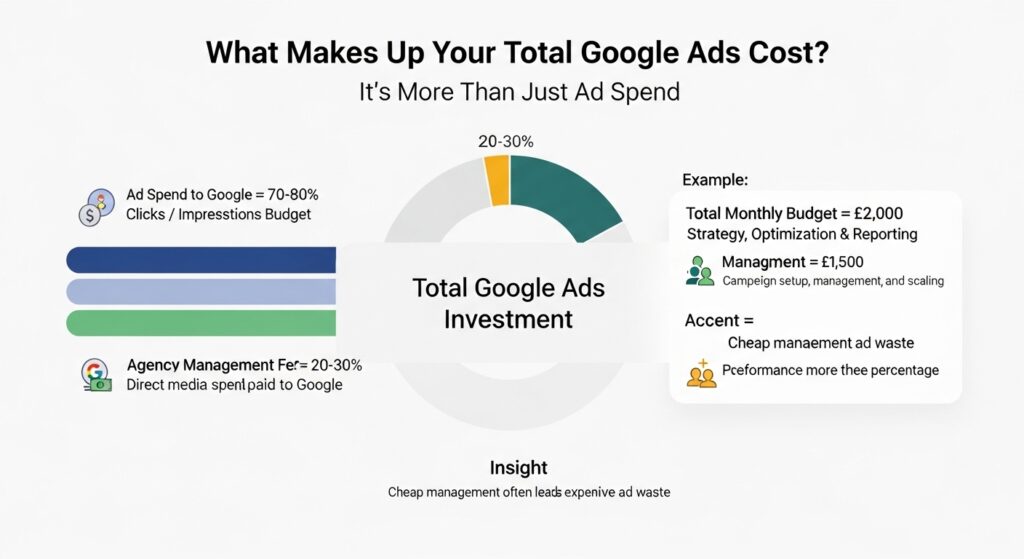
Google Ads cost UK refers to the total monthly expenditure a UK business incurs to run paid search campaigns comprising the ad spend paid directly to Google plus any agency or management fees. The average UK small business spends between £1,000 and £5,000 per month in total, though costs vary sharply by industry, competition, and campaign quality.
Quick note: when most people search this, they’re thinking about CPC (cost per click). That’s only part of the equation. We’ll get to the full picture shortly.
What UK Businesses Are Actually Paying: CPC Benchmarks by Industry
Let’s start with the number most people come here for.
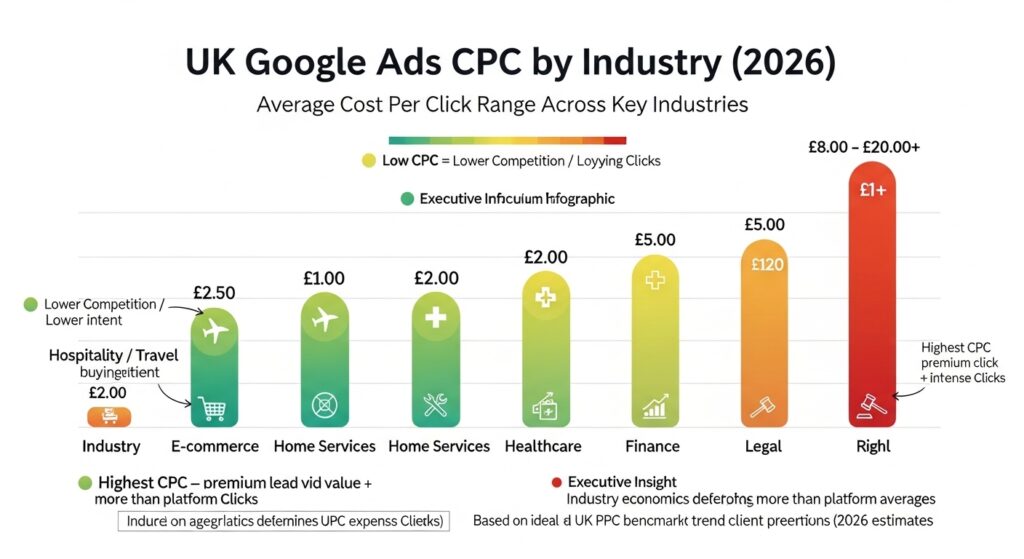
According to WordStream’s 2024 Google Ads Industry Benchmarks, the average cost per click on Google Search in the UK sits between £1.20 and £2.50 across all industries. That’s the mid-market reality for most SMEs. But averages hide a lot.
Here’s where it gets expensive fast.
Typical UK Google Ads CPC Ranges by Industry (2025–2026)
| Industry | Avg. CPC (UK) | Why It’s High or Low |
| Legal services | £15–£50+ | High lifetime client value, fierce competition |
| Finance & insurance | £8–£35 | Regulated sector, few quality advertisers |
| Home services (plumbing, etc.) | £3–£8 | Local intent, strong ROI drives bidding up |
| eCommerce / retail | £0.80–£3 | High volume, Shopping campaigns reduce CPC |
| Healthcare & dental | £2–£12 | Local and national mix, variable |
| Education & training | £2–£6 | Moderate competition, high intent |
The counter-intuitive insight here: a higher CPC doesn’t mean worse ROI. A solicitor paying £40 per click and converting 1 in 10 visitors into a £3,000 client is getting an excellent return. A retailer paying £1 per click with a 0.5% conversion rate might be bleeding cash. CPC alone tells you almost nothing about whether a campaign is working.
The Number Most Guides Skip: What Google Ads Really Costs Per Month
Here’s the thing: ad spend and Google Ads cost are not the same number.
Every article you’ll find lists CPC benchmarks. Almost none of them show you the full monthly outlay a UK business should expect. Let’s fix that.
The real monthly Google Ads cost has two components:
1. Ad Spend (paid directly to Google)
This is the money Google charges you when people click your ads. You set a daily budget, Google spends up to that limit. A typical UK SME running a focused local campaign might start at £500–£1,500/month in pure ad spend. A regional or national campaign often requires £2,000–£5,000+ to generate meaningful volume.
2. Management Fees (paid to your agency or specialist)
This is what most cost guides quietly omit. If you’re working with a PPC agency — and most SMEs do, because running Google Ads well is genuinely time-consuming — expect to pay either:
- A percentage of ad spend: typically 10–20% of monthly spend (so £100–£400/month on a £1,500 ad spend budget)
- A flat monthly retainer: typically £400–£1,500/month for SME accounts, depending on campaign complexity
- A hybrid model: smaller flat fee plus a performance percentage
Look, if you’re spending £1,000/month on ads and your agency is charging a £750 flat fee, your effective cost is £1,750. That’s not a criticism of agencies good management genuinely lowers your CPC over time. But you need to see the real number before you plan a budget.
Quick Comparison
| Setup | Ad Spend | Management Fee | Total Monthly Cost |
| DIY campaign | £1,000 | £0 | £1,000 |
| Agency (% model, 15%) | £1,500 | £225 | £1,725 |
| Agency (flat retainer) | £1,500 | £700 | £2,200 |
| Freelance PPC specialist | £1,500 | £400–£600 | £1,900–£2,100 |
These are indicative UK market rates. Actual fees vary by agency size and campaign scope.
Some experts argue that percentage-of-spend models create a conflict of interest the agency earns more if you spend more. That’s valid for larger accounts. But for SMEs under £3,000/month in spend, flat retainers can actually cost proportionally more. The right model depends on your scale.
What Actually Controls Your Google Ads CPC
Most guides stop at benchmarks. This section is where the real leverage is.
Your CPC on Google isn’t just determined by how much your competitors bid. Google uses a metric called Quality Score (scored 1–10 per keyword) to decide both whether your ad shows and what you pay per click. Higher Quality Score = lower CPC for the same position.
Quality Score is built from three components:
- Expected click-through rate how likely users are to click your ad vs. competitors
- Ad relevance how closely your ad copy matches the keyword someone searched
- Landing page experience whether your page loads fast, is mobile-friendly, and actually answers what the ad promised
Here’s the practical implication: two businesses bidding on the same keyword can pay completely different CPCs. A business with a Quality Score of 8 might pay £2.10 for position 2. A competitor with a Quality Score of 4 might pay £4.80 for position 3.
Or maybe I should say it this way Quality Score is effectively a discount on your ad spend. Google Ads Quality Score guide, Improving it from 4 to 7 on your core keywords can cut your CPC by 30–50% without touching your bids.
To improve Quality Score, follow these steps:
- Match ad copy to the exact keyword intent don’t run one generic ad for 30 different keywords
- Use ad groups with 5–15 tightly themed keywords each
- Send traffic to a dedicated landing page, not your homepage
- Ensure your landing page loads in under 3 seconds on mobile (test with Google PageSpeed Insights)
- Write at least 3 ad variations per ad group and let Google test them
I’ve seen conflicting data on the exact CPC discount per Quality Score point. Some sources cite Google’s own historical documentation showing up to 400% CPC difference between a score of 1 and 10, while others suggest real-world impact is closer to 20–50% across the 4–8 range. My read is the latter is more realistic for established campaigns, but even a 25% CPC reduction compounds significantly over a 12-month campaign.
How to Set a Realistic Google Ads Budget for a UK Business
This is the section most SMEs actually need. Not benchmarks. A method.
Step 1: Decide what a new customer is worth to you.
If your average client is worth £2,000 gross profit, you can afford to spend more per acquisition than a business where the average order is £40.
Step 2: Estimate your conversion rate realistically.
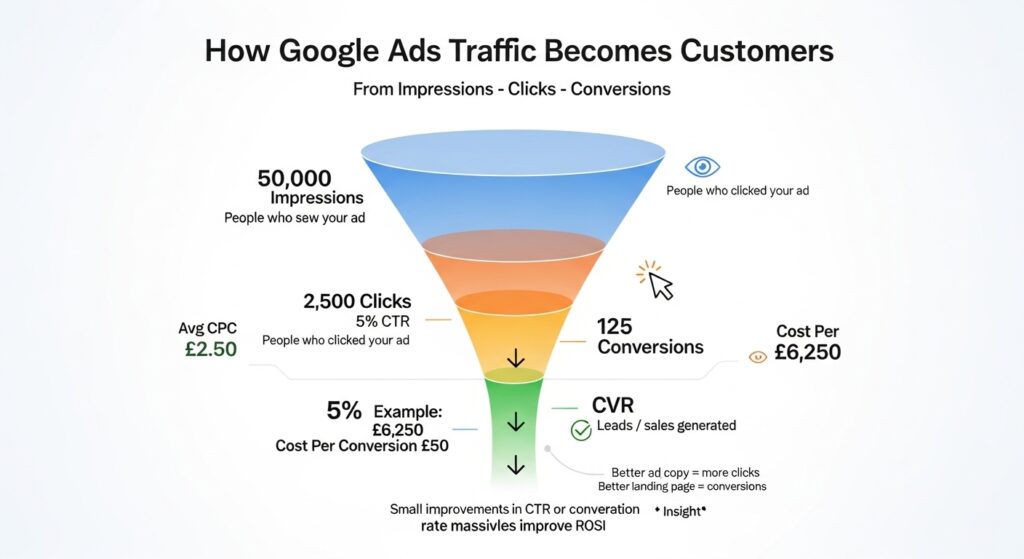
Industry-average conversion rates on Google Search in the UK range from 2–5% for most sectors (WordStream, 2024). If you don’t have data yet, use 3% as a starting assumption but plan to measure and adjust.
Step 3: Work backwards from target leads.
Want 20 leads per month? At 3% conversion, you need roughly 670 clicks. At £2.50 average CPC, that’s £1,675 in ad spend. Factor in a 15% management fee and your monthly total is around £1,925.
Step 4: Use Google’s own tools to validate.
Google Ads Keyword Planner gives you CPC estimates for specific UK keywords before you spend a penny. Google’s Performance Planner (inside an active account) forecasts results at different spend levels it’s genuinely useful once you have 30+ days of campaign data.
Step 5: Build in a 3-month learning window.
New campaigns rarely perform at their best immediately. Budget for a 3-month testing phase before judging ROI. Cutting a campaign after 3 weeks of data is the single most common mistake UK SMEs make with Google Ads.
🔗 Google Ads Keyword Planner (Official)
Industry-Specific Google Ads Cost Guidance for UK Sectors
Not every business should approach Google Ads the same way. Here’s what the numbers actually look like in practice for common UK sectors.
Home Services (Plumbers, Electricians, Roofers)
Local search competition is fierce in major UK cities. Expect £4–£10 CPC in London, £2–£5 outside. A monthly spend of £800–£1,500 is often enough for a sole trader targeting a single postcode area. Call extensions are essential, most conversions happen by phone, not form.
Professional Services (Solicitors, Accountants, Consultants)
This is where the CPC gets serious. Family law and personal injury keywords can exceed £40/click in competitive cities. A realistic monthly budget for a small legal firm is £2,000–£5,000 in ad spend alone. The ROI can still be excellent one retained client often covers months of spend.
ECommerce and Retail
Shopping campaigns typically deliver lower CPCs (£0.50–£2.00) than Search for the same product. A combined Search + Shopping approach with a £1,500–£3,000/month budget is a reasonable starting point for most UK online retailers. Google Ads for local businesses UK, Product feed quality matters enormously here.
Healthcare and Dental
Google has specific ad policies for healthcare. Certain treatments (including some cosmetic procedures) have restricted targeting options. Budget £1,000–£3,000/month for a local dental practice running appointment-focused campaigns. Patient lifetime value justifies the spend in most cases.
FAQs
Q: What’s the minimum budget for Google Ads in the UK?
A: Google has no official minimum, but campaigns under £300/month rarely generate enough data to optimise properly. Most UK SMEs need at least £500–£1,000/month in ad spend to see meaningful results within 60–90 days.
Q: How do I find out what CPCs cost in my specific industry before I start?
A: Use Google Ads Keyword Planner with your target keywords and UK location settings. It shows estimated CPC ranges based on current advertiser competition and no account spend required to access it.
Q: Should I manage Google Ads myself or hire an agency?
A: DIY works if you have 5–8 hours per week to learn and manage the platform and your monthly spend is under £1,000. Above that threshold, or if your time has high opportunity cost, agency management typically pays for itself through better Quality Scores and lower wasted spend.
Q: Why does my Google Ads cost more than a competitor’s for the same keyword?
A: Almost certainly a Quality Score gap. Lower Quality Score means Google charges you more for the same ad position. Improving your ad relevance and landing page experience directly reduces your CPC often within 2–4 weeks of changes.
Q: When should I increase my Google Ads budget?
A: Increase spend when your campaign is profitable at the current level not before. A campaign converting at a cost-per-acquisition below your target is the signal to scale. Increasing budget on a campaign that isn’t yet converting is the fastest way to waste money.
This guide covers Google Search and Shopping campaigns for UK SMEs spending up to £10,000/month. Google Ads management services, It does not cover YouTube Ads, Display Network campaigns, Performance Max at enterprise scale, or non-UK market dynamics.