
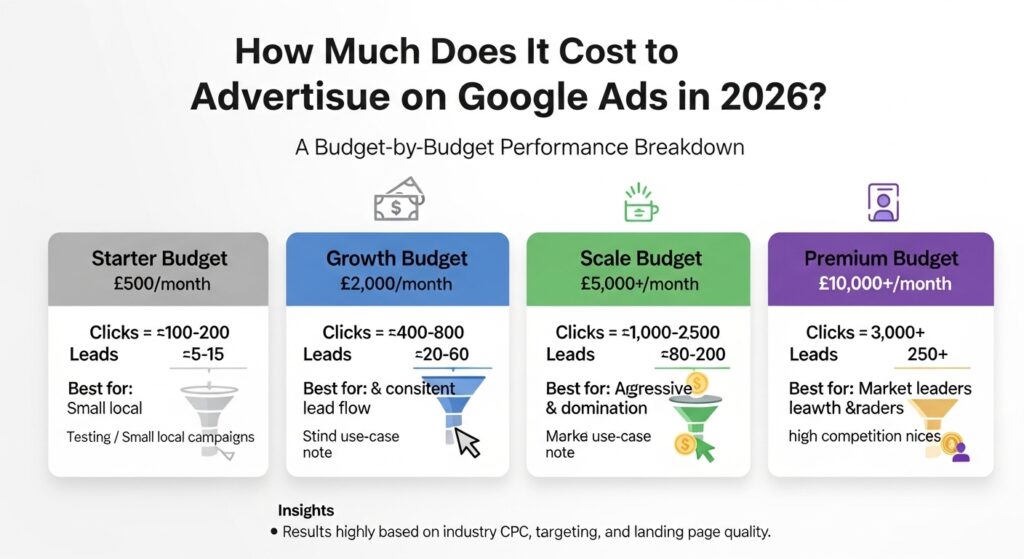
You’ve probably seen a range like $1 to $100+ per click somewhere online. That’s technically true. It’s also almost completely useless for deciding whether Google Ads is worth trying for your business.
Here’s what this article actually does: it gives you real numbers, by industry, by budget level, and by business type then shows you exactly what a specific monthly spend translates into in clicks, leads, and cost per lead. No vague ranges. No “it depends” cop-outs without context.
What Does “Advertising on Google Ads” Actually Cost?
Advertising on Google Ads works on a pay-per-click (PPC) model, meaning you only pay when someone clicks your ad. Your total monthly cost is determined by your daily budget cap multiplied by the number of days in the month. Average CPCs vary widely by industry, from under £1 to over £15 per click.
According to WordStream’s 2024 Google Ads Industry Benchmarks report, the average cost per click across all industries on Google Search is $4.22 (roughly £3.30 at current exchange rates). That’s the baseline but it’s the average across every niche from florists to personal injury lawyers, which makes it nearly meaningless on its own.
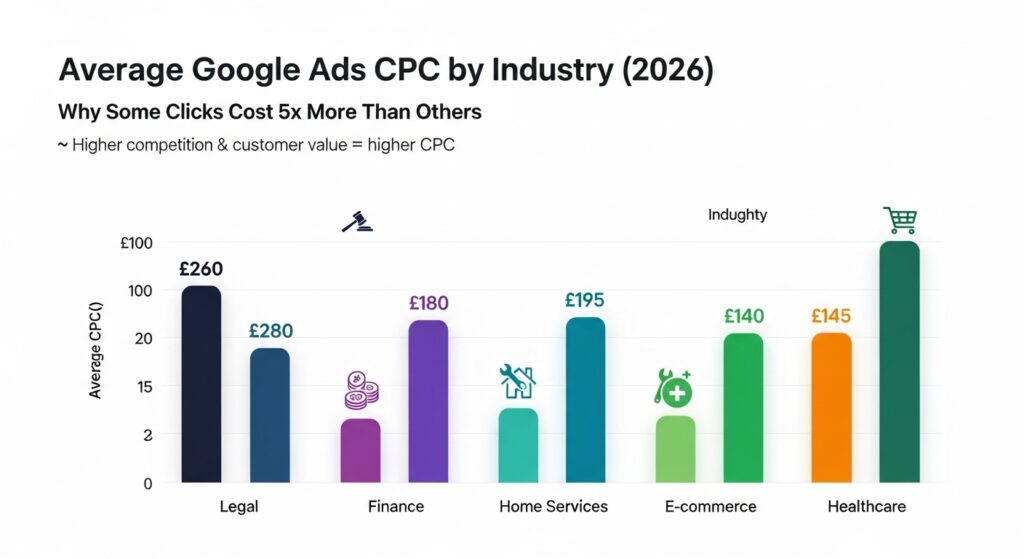
The legal industry averages $8.94 CPC. E-commerce sits at $1.16. Home services land around $6.40. If you’re a solicitor in Manchester competing for no win no fee terms, you’re not playing the same game as a Shopify store selling phone cases.
Most people assume a bigger budget automatically means better results. The data says otherwise Google’s own internal research shows that relevance score and landing page quality can reduce your CPC by up to 50%, meaning a well-structured £500/month campaign can outperform a poorly built £2,000/month one.
What’s the Minimum Budget to Run Google Ads Effectively?
There’s no official minimum. Google will technically let you run ads on £1/day.
But here’s the thing: that number means almost nothing in practice.
To exit Google’s learning phase the period during which its algorithm optimises delivery you generally need at least 30–50 conversions per month. If your target CPA (cost per acquisition) is £20, that means you need to spend at least £600–£1,000/month just to give the algorithm enough data to work with. Below that threshold, you’re essentially paying for an experiment that never gets to finish.
Practical minimum by business type:
| Business Type | Suggested Minimum Monthly Ad Spend | Why |
| Local service (plumber, dentist) | £500–£800 | Low search volume means budget stretches further |
| E-commerce (broad products) | £800–£1,500 | Competition is high; need volume to test |
| B2B / lead generation | £1,000–£2,000 | High CPC + long sales cycle needs data |
| Legal / financial services | £1,500–£3,000+ | CPCs are among the highest on the platform |
Quick Comparison Small Budget vs Scaled Budget:
A £500/month budget works best for hyper-local, low-competition keywords with a clear single offer. A £2,000/month budget is better suited for e-commerce or multi-service businesses because it generates enough conversion data to let Smart Bidding actually optimise. The key difference is whether your campaign can reach 30+ conversions/month.
The Worked Example Most Guides
This is the section both competitor articles don’t include. So let’s fix that.
Scenario: A local kitchen fitting company in Birmingham, spending £1,000/month on Google Ads
- Average CPC for kitchen fitters near me and related terms: approximately £2.80–£3.50 (home services, UK market)
- Monthly clicks at £1,000 budget: roughly 285–357 clicks
- Realistic conversion rate for a well-optimised landing page in home services: 4–6%
- Estimated leads per month: 11–21 leads
- Cost per lead: £48–£91
Now is that good? For a kitchen fitting job worth £8,000–£15,000, closing even two leads per month produces an ROI that dwarfs the ad spend. For a window cleaning round where each customer is worth £80/year, the maths looks entirely different.
Or maybe I should say it this way: the question isn’t whether Google Ads is expensive. It’s whether your customer lifetime value justifies your cost per lead.
To estimate your own budget, follow these steps:
- Find your target keyword’s average CPC using Google Keyword Planner (free inside any Google Ads account)
- Estimate your landing page conversion rate use 3% if you have no data
- Divide your desired monthly lead volume by that conversion rate to get clicks needed
- Multiply clicks needed by average CPC to get your minimum monthly budget
- Add 20% buffer for keyword variation and auction fluctuations
How Google Ads Pricing Actually Works: Auctions, Quality Scores, and What You Can Control
Google Ads doesn’t have a price list. Every click is an auction.
When someone types a search query, Google runs a real-time auction among all advertisers targeting that keyword. Your position in that auction isn’t determined by bid alone, it’s determined by Ad Rank, which is your bid multiplied by your Quality Score (a 1–10 rating based on expected click-through rate, ad relevance, and landing page experience).
This matters enormously for budget planning. An advertiser with a Quality Score of 8 can outrank a competitor with a Quality Score of 4 and pay less per click doing it.
What most guides skip is this: improving your Quality Score is the single highest-leverage activity a small-budget advertiser can do. A one-point Quality Score improvement can reduce your CPC by 16–20% according to WordStream’s benchmark analysis. On a £1,000/month budget, that’s £160–£200 back in your pocket every month.
Some experts argue you should just increase your bid to get better placement. That’s valid if you’re in a time-sensitive launch with no historical data. Explains how Ad Rank is calculated officially. But if you’re running ongoing campaigns, optimising Quality Score will always be cheaper long-term than outbidding the competition.
Google Ads Costs by Industry: Real Benchmarks for 2026
I’ve seen conflicting data on this, some sources cite 2022 figures as if they’re current, others pull US data and present it as universal. My read is that the WordStream 2024 benchmarks are the most cited and most methodologically transparent, so that’s what’s referenced below. UK CPCs tend to run 10–20% lower than US equivalents in most industries.
Average CPC by industry (Source: WordStream, 2024 US figures; apply ~15% reduction for UK estimates):
| Industry | Avg CPC (USD) | Est. UK CPC (GBP) | Avg CVR |
| Legal | $8.94 | £6.30 | 4.35% |
| Finance & Insurance | $5.15 | £3.63 | 5.10% |
| Home Services | $6.40 | £4.51 | 7.97% |
| Health & Medical | $4.85 | £3.42 | 3.36% |
| E-commerce | $1.16 | £0.82 | 2.69% |
| Real Estate | $2.37 | £1.67 | 2.47% |
| Education | $4.39 | £3.09 | 3.39% |
| Automotive | $2.08 | £1.47 | 6.03% |
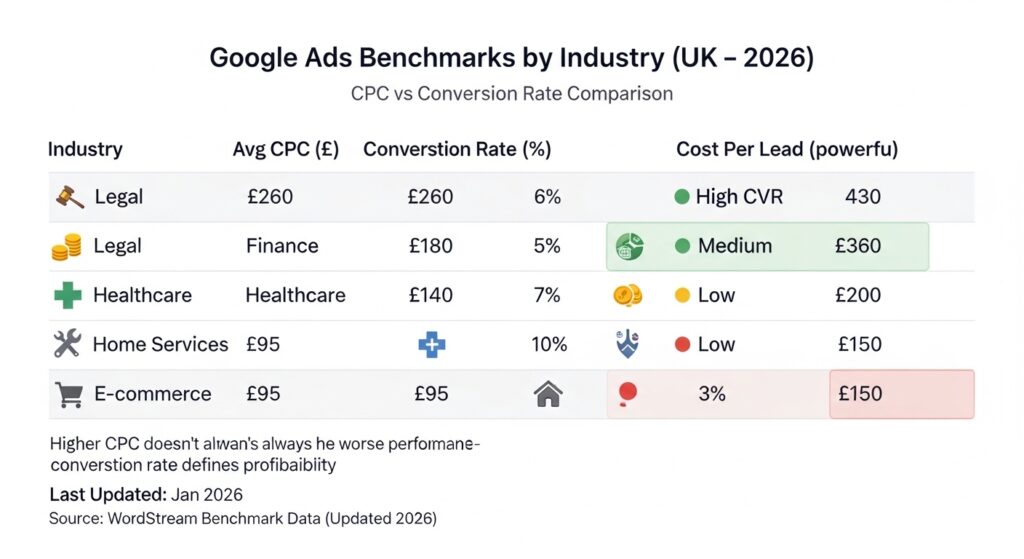
Quick note: conversion rate matters as much as CPC. Home services have a high CPC AND a high conversion rate meaning the cost per lead often ends up competitive despite the headline click price.
Look, if you’re a solicitor reading this, your £6+ CPCs aren’t going away. But a conversion rate of 4–6% on a high-intent keyword like “personal injury solicitor Birmingham” means you’re paying £100–£150 per lead. At case values of £2,000–£10,000, that’s still a profitable channel if your close rate is reasonable.
Agency Fees vs Ad Spend: What You’re Actually Paying
This is where most people get confused and where the fear of wasting money comes from.
When an agency quotes you £500/month management fee, that is separate from your ad spend. Your ad spend goes directly to Google. The agency fee pays for account setup, campaign management, reporting, and optimisation.
Typical breakdown for a small business:
- Ad spend: £500–£2,000/month (you pay Google directly)
- Agency management fee: £300–£800/month, or 10–20% of ad spend
- One-time setup/audit fee: £200–£500 (some agencies, not all)
The management-to-spend ratio matters. Paying £500/month management on a £500/month ad spend means half your budget is going to the agency the economics are tight. Most experienced Google Ads managers will tell you honestly that a 1:1 ratio isn’t ideal; aim for management fees to represent no more than 30–40% of total spend.
Google Ads Performance Planner (inside your Google Ads account) lets you simulate different budget scenarios and forecast impressions, clicks, and conversions before you commit a single pound. It’s free. Use it before any agency conversation.
FAQs
Q: What’s the minimum amount I should spend on Google Ads per month?
A: Most businesses need at least £500–£800/month to generate enough data for Google’s algorithm to optimise effectively. Below this, campaigns rarely exit the learning phase before you run out of patience or budget.
Q: How do I work out what Google Ads will cost for my business?
A: Use Google Keyword Planner to find average CPCs for your target keywords, estimate a 3–5% conversion rate, then multiply clicks needed by CPC. Add 20% for fluctuation. This gives a realistic monthly floor.
Q: Should I manage Google Ads myself or hire an agency?
A: If your monthly budget is under £500, self-management makes more financial sense agency fees at that level eat too much of your spend. Above £1,000/month, professional management typically pays for itself through improved Quality Scores and lower CPCs.
Q: Why does Google Ads cost so much in some industries?
A: High CPCs reflect advertiser competition, not Google’s pricing. In legal and finance, the customer lifetime value is high enough that businesses bid aggressively. According to WordStream’s 2024 data, legal keywords average $8.94 per click in the US.
Q: When should I increase my Google Ads budget?
A: Increase spend when your campaigns are profitable and data-sufficient — meaning you’re getting 30+ conversions/month and your cost per acquisition is below your target. Scaling an unprofitable campaign just loses money faster.
This guide covers Google Search campaign budgeting for businesses spending £500–£10,000/month. It does not address Shopping campaigns, Performance Max, or YouTube advertising, which have different cost structures and optimisation logic.