
You’ve heard Google Ads works. You’ve probably also heard horror stories business owners burning through £500 in a week with nothing to show for it. So which is true?
Both, honestly. And the difference usually comes down to one thing: whether your budget matches your market.
This breakdown covers real 2026 UK cost data by industry, what agency management actually adds to the bill, and the part most guides skip how many leads you can realistically expect at different budget levels before you spend a single pound.
What “Google Ads Cost” Actually Means (And Why Most People Confuse It)
Google Ads cost for small businesses refers to the total monthly spend across three components: your ad budget (paid directly to Google), platform management fees (if using an agency or freelancer), and the hidden cost of wasted spend from poor campaign structure. These three elements together determine your real cost per lead.
Most articles talk about cost-per-click like it’s the whole story. It isn’t.
Your CPC is what you pay each time someone clicks your ad. But CPC alone tells you nothing about what that click is worth or whether the person who clicked ever called you, filled in a form, or bought anything.
Here’s the thing: a £4 click from someone searching emergency plumber London is worth ten times more than a £1 click from someone searching how does plumbing work. Same campaign. Wildly different value.
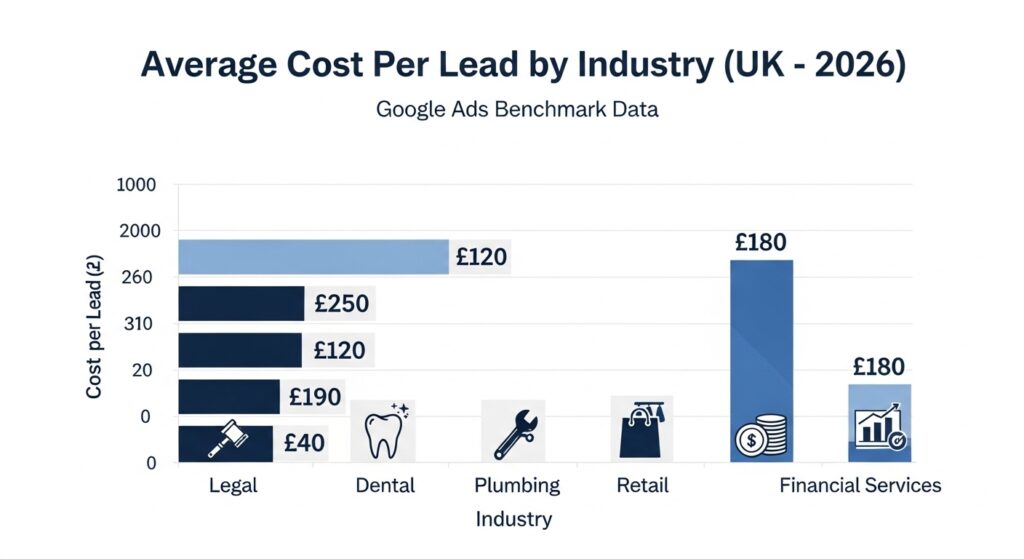
The real number you should care about is cost per lead (CPL) and in the UK, that number has moved significantly. According to WordStream’s Google Ads Benchmarks (cited by Whitehat SEO, 2025), the average cost per lead across all UK industries hit £70.11 in 2025, up 5.13% from £66.69 the year before. That’s your baseline before you’ve even thought about which industry you’re in.
UK Google Ads Cost Benchmarks by Industry in 2026
This is where most budget conversations should start and almost never do.
Your industry determines your CPC more than almost anything else. A solicitor competing for personal injury claims in Manchester is in a completely different auction than a florist in Cardiff bidding on wedding flowers near me. Treating them the same way is where small business owners get hurt.
Quick Comparison Table
| Industry | Avg. CPC (UK, 2026) | Avg. Cost Per Lead | Typical Monthly Budget |
| Legal / Solicitors | £8–£22 | £131.63 | £2,000–£5,000 |
| Financial Services | £7–£18 | £115–£140 | £1,500–£4,000 |
| Dental / Healthcare | £4–£9 | £68–£95 | £800–£2,500 |
| Home Services (plumbing, electrical) | £3–£7 | £28.50–£55 | £500–£1,500 |
| Retail / eCommerce | £0.80–£3 | £35–£65 | £500–£3,000 |
| Education / Training | £2–£6 | £55–£90 | £600–£2,000 |
Source: WordStream Google Ads Benchmarks 2025, Whitehat SEO UK industry analysis validates UK CPL data by industry.
Some experts argue that CPCs are dropping due to increased AI-driven bidding efficiency. That’s valid for large accounts where Smart Bidding has sufficient conversion data to optimise properly. But if you’re running a small account with fewer than 30 conversions per month which describes most small businesses the auction still works largely against you, and CPCs in competitive sectors haven’t softened meaningfully.
One counter-intuitive insight worth flagging: rural and regional businesses often pay less per click but more per lead because lower search volume means fewer clicks, so the pipeline dries up faster. A solicitor in Cardiff may pay under £1 per click (as noted by Whitehat SEO) but still struggle to generate consistent lead volume at a £500/month budget.
The Budget Reality Check: What £500, £1,500, and £3,000/Month Actually Buys You
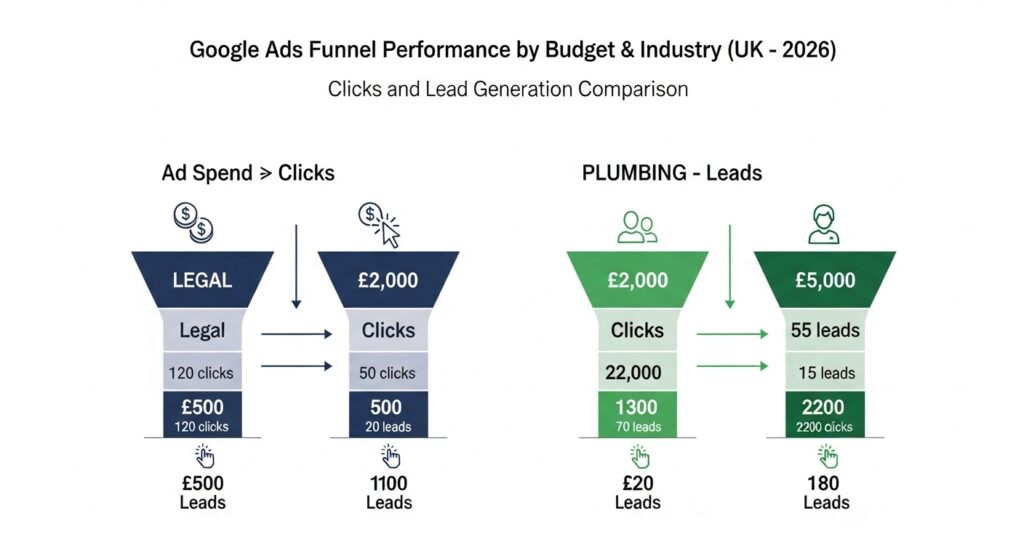
This is the table that neither of the top-ranking competitors provides. It’s also the table every small business owner actually needs.
Or maybe I should say it this way the question isn’t how much does Google Ads cost? It’s how much do I need to spend to get X results in my industry?
Minimum Viable Budget by Industry: Projected Lead Volume
| Monthly Ad Budget | Home Services (CPL ~£40) | Dental (CPL ~£80) | Legal (CPL ~£130) | Retail (CPL ~£50) |
| £500/month | 10–12 leads | 5–6 leads | 3–4 leads | 8–10 leads |
| £1,500/month | 32–37 leads | 17–19 leads | 10–12 leads | 26–30 leads |
| £3,000/month | 65–75 leads | 35–40 leads | 20–23 leads | 54–60 leads |
Projections based on WordStream 2025 UK CPL averages. Assumes well-structured campaigns with correct keyword match types and active negative keyword lists. Results will vary.
Quick note: these projections assume the campaigns are set up properly. A poorly structured campaign broad match keywords, no negative keyword list, landing page that doesn’t match the ad can reduce lead volume by 40–60% at the same budget. That’s not a hypothetical. Users who’ve run DIY Google Ads without correct match type settings consistently report burning through budget in days with minimal conversions to show for it.
Look if you’re a plumber in Birmingham with £500/month and you set up Google Ads correctly, 10–12 leads per month is genuinely achievable. But if you’re a solicitor with the same budget, you’re likely generating 3–4 leads at best, which may not justify the spend unless your average case value is high.
Agency Fees and Management Costs: What You’re Actually Paying For
Let’s talk about the number Google doesn’t charge you but that still hits your budget.
If you use a PPC agency or freelancer, management fees in the UK typically fall into one of three structures.
To understand what you’re paying an agency for, look at these three cost structures:
1. Percentage of ad spend: typically 10–20% of your monthly budget paid to Google
2. Flat monthly retainer: usually £300–£800/month for small accounts
3. Performance-based: a fixed fee plus bonus for leads or ROAS targets met
For a small business spending £1,000/month on ads, you’re realistically looking at an all-in cost of £1,300–£1,800/month when agency fees are included depending on the model your agency uses and the complexity of your campaigns.
What most guides skip is the cost of not using an agency when you don’t know what you’re doing. I’ve seen conflicting data here some sources suggest DIY campaigns waste 25–40% of budget on irrelevant clicks; others put that number closer to 50–60% for first-time accounts without proper negative keyword lists. My read is that 35–40% wasted spend is a realistic estimate for self-managed beginners which effectively inflates your real CPC by a third before you’ve even started optimising.
The tools worth knowing here: Google Ads Keyword Planner lets you forecast realistic click volumes and CPCs before you spend anything use it to sanity-check your budget before launching. WordStream provides the industry benchmark data that should anchor any serious budget conversation. And Google Smart Bidding (including Performance Max, which Google is pushing hard in 2026) can theoretically optimise bidding automatically but it needs conversion data to function well, and small accounts often don’t generate enough volume to feed the algorithm properly in the first month. Which bidding strategy works for small budgets?
The Hidden Cost Nobody Talks About: Wasted Spend from Poor Campaign Structure
This is where small business owners lose the most money. And it’s rarely discussed in cost guides because it’s uncomfortable.
Broad match keywords are the default in Google Ads. They’re also how a plumber bidding on boiler repair ends up paying for clicks from people searching how to repair a boiler yourself or boiler repair training courses. These clicks cost the same. They convert at essentially zero.
DIY Google Ads vs. Agency-Managed Google Ads:DIY is better suited for businesses with simple, single-service campaigns and an owner willing to invest time weekly in optimisation. Agency management works better when budget exceeds £1,000/month, multiple services or locations are targeted, or previous self-managed campaigns underperformed. The key difference is not cost it’s conversion rate and wasted spend control.
Three specific campaign errors account for the majority of wasted spend in small business accounts:
- Missing negative keywords: blocking irrelevant search terms that drain budget without generating leads
- Wrong match types: broad match without Smart Bidding data causes indiscriminate click spending
- Mismatched landing pages: sending emergency boiler repair clicks to a generic homepage kills Quality Score and raises your CPC over time
A lower Quality Score doesn’t just mean worse ad positions it means you pay more per click than a competitor with a better-structured account, even if you’re bidding the same amount. This is the mechanism most DIY guides explain poorly. Negative keyword strategy for small budgets!
Should You Use Google Ads at All? Honest Answer for Small UK Businesses
Not every small business should be running Google Ads. That’s an opinion some agencies won’t say out loud but it’s true.
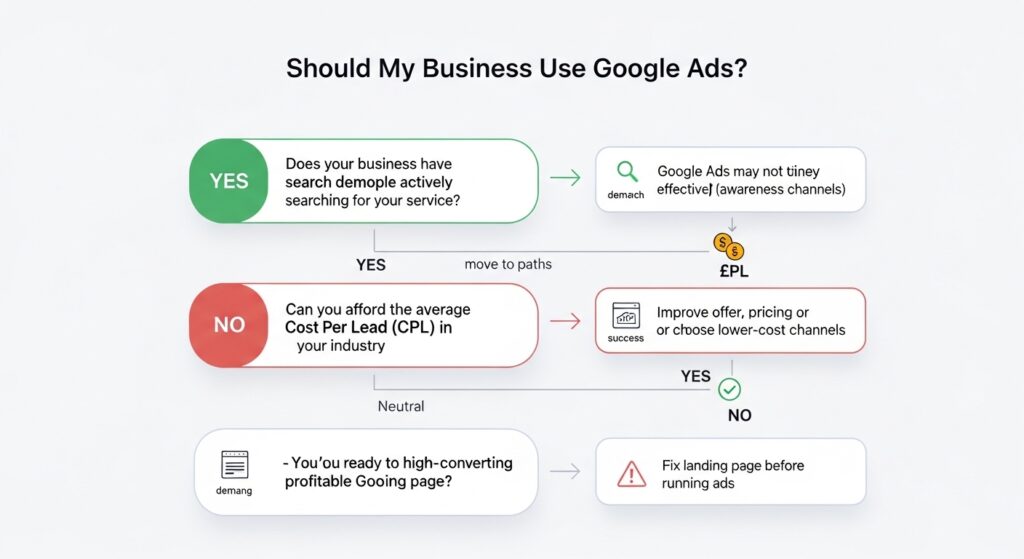
Google Ads works best when three conditions are met: people are actively searching for what you sell, your average order or case value justifies the cost per lead, and you have a landing page that actually converts visitors. If any of those three are missing, you’ll spend money and feel like the platform doesn’t work when really the conditions weren’t right.
For most UK home services businesses, local retail, dental practices, and professional services (solicitors, accountants, IFAs), all three conditions typically exist. For niche B2B products, very new categories where search demand is low, or businesses with margins too thin to absorb a £50–£130 CPL Google Ads is often the wrong first channel.
Anyway, the question most small business owners should ask isn’t how much does Google Ads cost? It’s what’s one new customer worth to me, and how many do I need per month to justify this spend? Work backwards from that number, cross-reference it with the CPL benchmarks above, and you’ll know within five minutes whether the budget conversation is even worth having.
FAQs
Q: What’s the minimum budget for Google Ads in the UK?
A: For most UK small businesses, £500/month is the realistic minimum below that, you won’t generate enough data or clicks to optimise effectively. Competitive sectors like legal and finance typically need £1,500+ to see consistent results.
Q: How much do agencies charge to manage Google Ads in the UK?
A: UK PPC agencies typically charge 10–20% of your monthly ad spend, or a flat retainer of £300–£800/month for small accounts. Expect total monthly costs (ads + management) of £1,300–£1,800 at a £1,000/month ad budget.
Q: Should I run Google Ads myself or hire an agency?
A: If your monthly ad budget is under £500 and your campaign targets one service in one location, DIY is manageable with proper training. Above £1,000/month or across multiple services, agency management typically pays for itself through reduced wasted spend.
Q: Why is my Google Ads cost per click so high?
A: High CPCs usually result from low Quality Scores (poor ad-to-landing-page relevance), high-competition keywords, or broad match settings sending your budget to irrelevant searches. Fixing keyword match types and improving landing page relevance reduces CPC over time.
Q: When should I increase my Google Ads budget?
A: Increase budget when your campaigns are consistently hitting target CPL, conversion rate is stable above 3–5%, and you’re losing impression share to competitors not before. Scaling a poorly optimised campaign just scales the waste.
This guide covers standard Google Ads Search and Performance Max campaigns. It does not address Google Shopping feeds, Display remarketing, or YouTube pre-roll all of which have different cost structures and benchmarks.
Google Ads is a paid advertising platform. Results depend on industry, campaign quality, landing page performance, and market conditions. This article does not constitute financial or marketing advice.